How it Works
WPP, Havas, Omnicom: Are advertising’s biggest holdcos recasting agencies as AI Operating Systems?
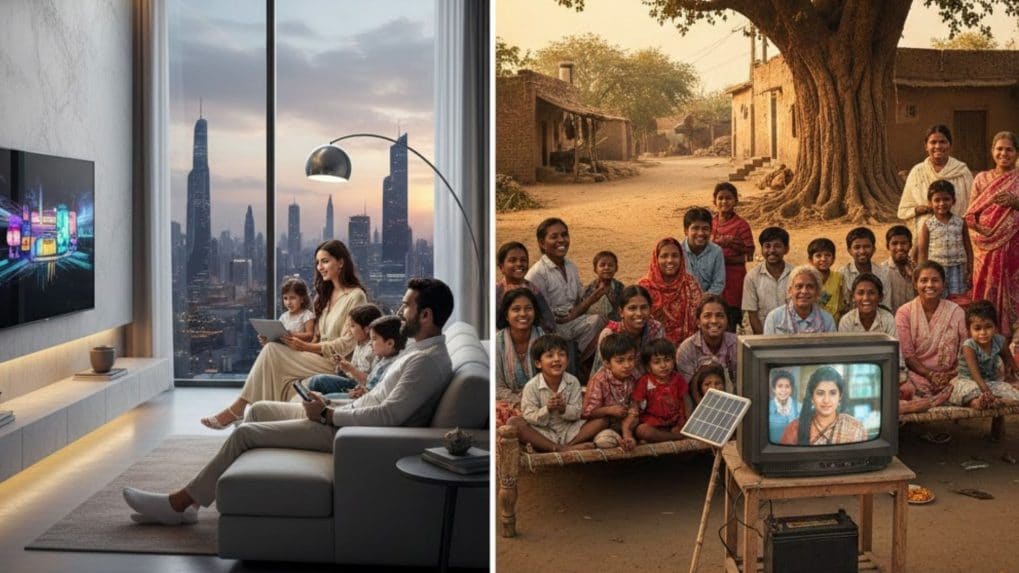
The Future of TV In India report by Viswanath Pingali, Professor, Economics, IIM Ahmedabad and Ankur Sinha, Professor, Operations & Decision Sciences - IIM Ahmedabad examines whether television viewership in India is in structural decline or entering a new phase of expansion. Using multi-year state-level data and panel regression analysis, the study finds that television audiences in India are expected to grow at approximately 2 to 3 percent annually, indicating that TV remains a resilient and expanding medium rather than a fading one.
As Pingali notes, “We are expecting growth of around two to three percent every year in TV audiences as well as the TV market, since the two are directly related.” The results challenge the common assumption that digital adoption necessarily erodes TV consumption.
The analysis identifies internet penetration, income growth, literacy rate, and dependency ratio as the most influential drivers of TV viewership across India. Among these, internet subscribers emerge as the strongest and most consistent predictor of audience expansion across national, rural, and low-income models. Importantly, rising internet adoption is not interpreted as a proxy only for connected TV usage.
Sinha explains that “Internet subscribers should not be interpreted to mean that only connected TV will grow… it represents broader signals such as affluence, electricity access, and overall household readiness.” In effect, internet growth functions as a structural enabler of TV ownership and consumption rather than a pure substitute.
Income growth plays a differentiated role across regions. While per-capita income does not significantly influence TV growth in wealthier states, it becomes a major accelerator in rural and low-income regions, where affordability constraints are more binding. Empirical estimates suggest that increases in rural income levels are associated with sharp increases in TV audience size, indicating that future TV expansion will be disproportionately driven by poorer and semi-urban geographies.
According to Pingali, “If income levels increase, TV viewership growth is significantly higher, especially in rural areas where growth is expected to outpace urban regions.”
Demographic change also contributes to TV resilience. The study finds that higher dependency ratios, driven in part by population aging, are associated with increased TV consumption. As societies age, television continues to function as a primary medium for entertainment and information among older cohorts.
Sinha observes that “As countries develop, dependency ratios tend to rise due to population aging, and our data shows TV viewership increases alongside this shift.”
Literacy rate shows a similarly positive relationship with TV growth. Rising literacy appears to strengthen engagement with televised content, reinforcing TV’s role as both an informational and social medium. The report further situates television within a broader body of evidence linking TV exposure to improved literacy, social awareness, and women’s empowerment, particularly in rural India.
Regionally, the report projects that India’s total TV audience will approach one billion viewers by 2029, with the fastest growth expected in rural India and low-income states such as Uttar Pradesh, Bihar, Odisha, Rajasthan, and West Bengal. These regions are projected to converge toward penetration levels currently seen in higher-income states, underscoring the role of economic catch-up in expanding TV reach.
Urban markets, by contrast, are expected to grow more slowly, largely due to already high penetration levels. However, the authors caution against interpreting this as market saturation.
Pingali states, “I would not describe TV in urban India as reaching saturation. Growth is slower because penetration is already high, not because demand is collapsing.”
The study does not explicitly differentiate between linear television and connected or online TV, but argues that linear TV is unlikely to be bypassed, especially in emerging regions. Rather than a replacement dynamic, the authors anticipate hybrid growth, with connected TV expanding faster while traditional TV continues to gain users.
Sinha notes, “It is unlikely that households without TV access will skip linear TV entirely and move straight to non-linear TV. We expect mixed growth, not substitution.”
The report acknowledges limitations, particularly in its inability to directly model content-side variables such as language diversity, regional programming penetration, and broadcaster reach. These are indirectly proxied through income and connectivity metrics. Future research, the authors suggest, could benefit from deeper segmentation of regional language ecosystems, especially in underserved markets such as the Northeast.
Pingali adds, “India’s diversity is far more complex than current datasets capture. Regional content availability is one variable we would most like to study in greater depth.”
Overall, the study concludes that television in India is not in decline but entering a new phase of structurally supported growth, driven by rising connectivity, incomes, literacy, and demographic shifts.
As Sinha summarizes, “This study began as an attempt to test the hypothesis that TV is dying. Our conclusion is that TV is not dying.”
From purpose-driven work and narrative-rich brand films to AI-enabled ideas and creator-led collaborations, the awards reflect the full spectrum of modern creativity.
Read MorePraveen Someshwar, Managing Director and CEO of Diageo India, joins the Grand Jury of the Storyboard18 Awards for Creativity, highlighting the awards’ focus on work that blends cultural relevance with strategic and commercial impact.