Advertising
From Pink Slips to Silent Sidelining: Inside adland’s layoff and anxiety crisis
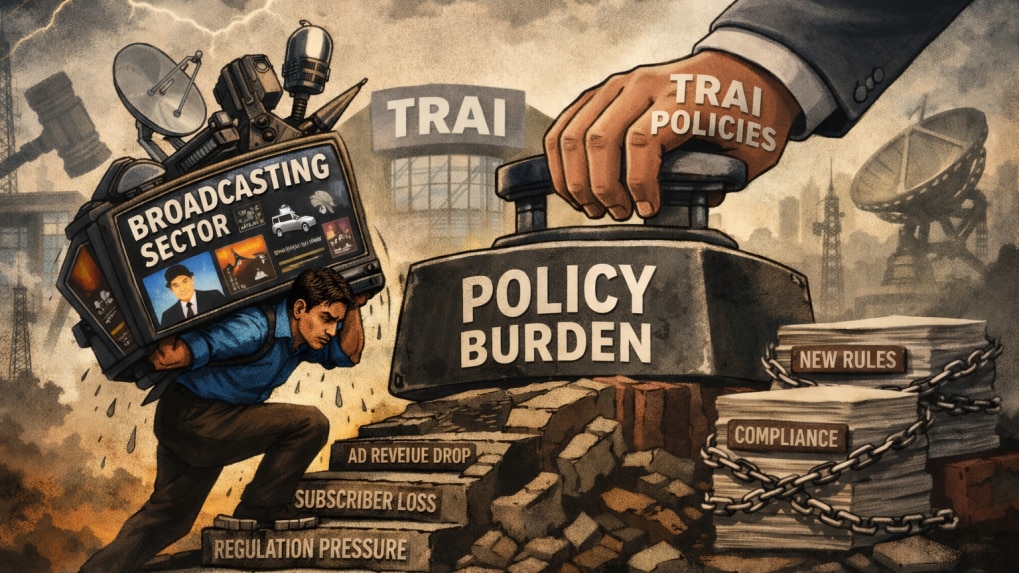
India’s broadcasting sector is entering a critical policy phase as revenue pressures on television deepen even while the sector continues to expand in scale and regulatory oversight intensifies. A comparison of the Telecom Regulatory Authority of India’s (TRAI) Annual Reports for FY24 and FY25 suggests that regulatory intervention, rather than market momentum, is now central to the sector’s future trajectory.
While the number of channels, operators and distribution platforms remains large, topline growth has weakened, advertising revenues continue to slide, and pay television subscribers are steadily declining—prompting policymakers to accelerate reforms under the National Broadcasting Policy and the Telecommunications Act, 2023.
TRAI data shows that the Indian television industry has now seen two consecutive years of revenue contraction.
Television industry revenue declined from ₹70,900 crore in 2022 to ₹69,600 crore in 2023-24, a fall of 1.8%, according to the FY24 report. In calendar year 2024, revenues declined further to ₹67,900 crore, as reported in the FY25 document.
The sustained decline highlights the structural challenges facing linear television, even as it remains a dominant medium in reach terms.
Advertising Weakness Emerges as Core Policy Concern
A closer breakdown of revenues reveals why advertising has become a key focus area for regulators. Advertisement revenue fell from ₹31,800 crore in 2022 to ₹29,700 crore in 2023-24, and slipped further to ₹29,400 crore in 2024-25.
In contrast, subscription revenue has been relatively resilient, rising to ₹39,900 crore in 2023 before moderating to ₹38,500 crore in 2024. The divergence has sharpened concerns within policy circles about broadcaster viability, especially for news and regional channels that rely heavily on ad-led models.
Pay TV Subscriber Decline Accelerates
Distribution data reinforces the urgency behind ongoing regulatory consultations.
Pay DTH subscribers declined from 61.97 million as of March 2024 to 56.92 million by March 2025, a loss of more than 5 million subscribers in a single year.
Cable TV households also fell from around 62 million to 60 million during the same period.
In contrast, DD Free Dish, the government-run free-to-air DTH platform operated by Prasar Bharati, has emerged as a stabilising force, reaching an estimated 49 million households, particularly in rural and low-income regions.
This shift has direct implications for policy decisions around channel pricing, addressability, and public service broadcasting.
Channel Consolidation Reflects Market Stress
The reports also point to early signs of consolidation:
The number of permitted satellite TV channels declined from 922 in FY24 to 918 in FY25.
The number of broadcasters fell from approximately 333 to 329 over the same period.
Experts view this as a signal that broadcasters require policy support or eased compliance to survive.
Radio Offers a Contrasting Policy Narrative
FM radio stands out as a relatively stable segment from a regulatory perspective.
Private FM radio advertising revenue increased from ₹1,775.79 crore in FY24 to ₹1,818.71 crore in FY25, nearly returning to pre-pandemic levels.
The number of private FM stations remained steady at 388, while operational community radio stations increased from 494 to 531.
The data strengthens the case for TRAI’s push on digital radio policy and FM auction reforms, with radio increasingly seen as a resilient local medium.
Policy Outlook: Regulation as the Growth Lever
TRAI’s data makes one trend clear: India’s broadcasting sector is no longer driven primarily by market expansion, but by regulatory recalibration.
As advertising remains under pressure and pay TV subscribers continue to decline, policymakers are increasingly positioning regulation as a stabilising force—through pricing reforms, distribution transparency, public broadcasting expansion, and digital convergence frameworks.
Ease in regulatory and policy reforms will determine whether broadcasting remains a mass-reach pillar of India’s media economy or gradually cedes ground to digital-first platforms.
From purpose-driven work and narrative-rich brand films to AI-enabled ideas and creator-led collaborations, the awards reflect the full spectrum of modern creativity.
Read MoreLooking ahead to the close of 2025 and into 2026, Sorrell sees technology platforms as the clear winners. He described them as “nation states in their own right”, with market capitalisations that exceed the GDPs of many countries.