Advertising
From Pink Slips to Silent Sidelining: Inside adland’s layoff and anxiety crisis
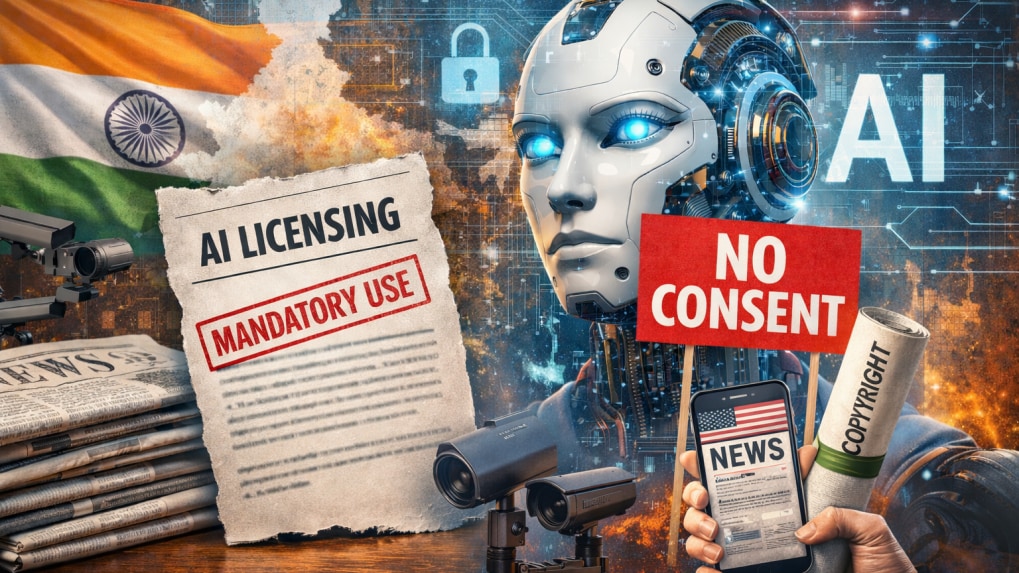
India’s digital news publishers have mounted a strong opposition to the Department for Promotion of Industry and Internal Trade’s (DPIIT) working paper proposing a new “hybrid” licensing framework for the use of copyrighted content in training artificial intelligence models, warning that the move could severely undermine the news industry, weaken intellectual property protections, and create regulatory and national security risks.
Publishers have argued that the proposed framework fundamentally mischaracterises news content by placing it on par with films, music and other entertainment-focused copyrighted works. Unlike creative content produced primarily for consumption or leisure, news content performs a public function by disseminating information, shaping public opinion and advancing national interest.
Treating news content under a blanket licensing model, they contend, ignores its time-sensitive and civic value. Publishers cautioned that a zero-permission or zero-price statutory licence for AI training could harm the long-term sustainability of India’s “Orange Economy”, which the working paper itself claims to protect.
Publishers push back against DPIIT’s AI licensing proposal
A key concern raised by publishers is the absence of any demonstrated public necessity or public interest justification for the proposed hybrid model. They argue that the framework effectively strips content creators of their right to decide whether and how their work is licensed, while overwhelmingly benefiting AI developers by granting them irreversible access to copyrighted material. Once news content is ingested into AI training datasets, publishers note, there is no practical mechanism to withdraw consent or opt out, making the proposed one-size-fits-all statutory approach particularly problematic.
FDI and national security concerns flagged
Publishers have also flagged serious policy risks arising from the proposed licensing regime, particularly in relation to foreign direct investment and national security. They warned that the framework would allow foreign AI developers to ingest Indian news content and generate news outputs for Indian audiences without being subject to existing regulations governing print, broadcast and digital news media. This, they argue, effectively circumvents India’s foreign direct investment policy, which caps overseas investment in digital news and current affairs at 26%.
Given that AI systems can be influenced or controlled by foreign governments, publishers cautioned that such unrestricted access could enable foreign entities to shape public discourse in India, while eroding domestic publishers’ ability to prevent misinformation, biased narratives or external influence on public opinion.
Another major criticism is the lack of any economic assessment underpinning the proposed hybrid model. Publishers pointed out that the working paper does not rely on market data or economic analysis to justify compulsory licensing or to support concerns around copyright “holdouts”. On the contrary, they note that global market trends show a clear preference for voluntary licensing, with more than 100 publicly reported licensing agreements already in place between copyright holders and AI companies. Imposing an involuntary licensing regime without such evidence, they argue, risks distorting markets and discouraging investment in high-quality journalism.
From a legal standpoint, publishers contend that the proposed framework is fundamentally inconsistent with the Copyright Act, 1957. They argue that a mandatory, non-waivable licence would infringe statutory rights relating to reproduction, storage, assignment and licensing of works, while amounting to an effective expropriation of intellectual property.
The open-ended and irreversible nature of the proposed licence, they say, goes far beyond the limited scope traditionally associated with compulsory licensing under Indian law. Publishers have also raised concerns about the erosion of authors’ moral rights, warning that AI-driven ingestion and repurposing of news content could lead to distortion or modification of original works without any meaningful recourse for creators.
Concerns have also been raised about India’s international obligations. Publishers argue that a universal mandatory licence with flat-rate remuneration would undervalue high-quality journalism and original reporting, while exceeding the flexibilities allowed under international copyright treaties. They have further questioned the reliance on collective management organisations for royalty distribution, citing structural inefficiencies, opaque financial practices and a lack of competitive incentives that could disadvantage news publishers and individual creators.
Publishers have also objected to the absence of royalties during the AI training phase. They argue that AI developers derive substantial economic value and valuations during training and testing, long before any formal commercial launch, and that treating training as non-commercial creates a significant loophole. Flat-rate pricing mechanisms, they add, would further undermine fair negotiation by preventing publishers from reflecting the true value and time sensitivity of news content.
Heavy compliance burden on publishers
The proposed framework has also been criticised for failing to account for publishers and media organisations developing their own proprietary AI models. Mandating these entities to make their proprietary datasets available to competing AI developers, publishers argue, would create conflicts of interest and foster anti-competitive outcomes. They also flagged the compliance burden imposed by the framework, particularly the requirement to register individual works, calling it logistically unfeasible and likely to exclude large volumes of protected content from any compensation mechanism.
Publishers further warned that the working paper does not adequately address the regulation of foreign-trained AI models that are developed overseas but deployed in India. Once such models ingest Indian news content, they argue, there would be no effective legal or practical recourse for Indian right holders, creating an enforcement vacuum. The absence of international reciprocity, they added, could ultimately harm India’s domestic AI ecosystem by granting foreign developers extensive access to Indian content without securing reciprocal rights for Indian AI firms abroad.
Beyond legal and economic implications, publishers cautioned that unrestricted AI ingestion of news content could have profound editorial consequences. Generative AI systems are prone to hallucinations and inaccuracies, and when applied to licensed news datasets without oversight, could damage publisher credibility and contribute to the spread of misleading information. The certainty of large-scale AI ingestion, they warned, could also discourage investigative and sensitive journalism, as newsrooms reassess the risks of publishing stories that may be easily decontextualised or misused by AI systems.
Publishers have also criticised the lack of transparency in the proposed framework, arguing that the suggested disclosure mechanisms are insufficient to allow right holders to verify compliance with licensing terms. They have called for transparency obligations aligned with global standards, including requirements for detailed disclosures of training datasets, metadata maintenance, crawler activity logs and independent audits.
Publishers call for voluntary, opt-in model
In their submission, publishers have urged the government to reject the proposed hybrid licensing model in favour of a voluntary, opt-in framework, and to recognise news content as a distinct category deserving of exemption from mandatory AI training licences. They have also called for upfront licensing fees for the AI training phase, followed by recurring royalties, and stressed that any such regime must be preceded by a comprehensive AI law that clearly defines accountability, safety and liability, and is shaped through meaningful consultation with stakeholders from the creative and news industries rather than being driven solely by technology sector interests.
From purpose-driven work and narrative-rich brand films to AI-enabled ideas and creator-led collaborations, the awards reflect the full spectrum of modern creativity.
Read MoreLooking ahead to the close of 2025 and into 2026, Sorrell sees technology platforms as the clear winners. He described them as “nation states in their own right”, with market capitalisations that exceed the GDPs of many countries.