How it Works
WPP, Havas, Omnicom: Are advertising’s biggest holdcos recasting agencies as AI Operating Systems?
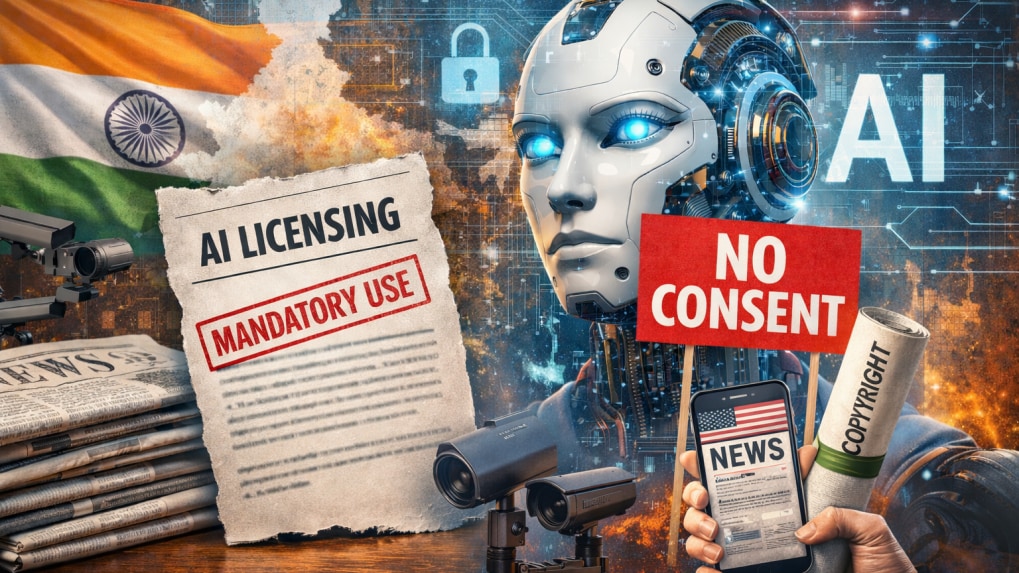
As India moves closer to formalising how artificial intelligence systems can access copyrighted content, publisher licensing deals remain economically small for AI companies but strategically significant for the media ecosystem. While global headlines have spotlighted high-value agreements between AI firms and major newsrooms, industry experts say licensing still accounts for a marginal share of AI revenues. In India, however, regulatory choices could determine whether this market remains niche or scales rapidly.
Rishi Sen, Founder and Chief Brand Architect at The Sixth Sen, estimates that publisher licensing currently contributes only a low single-digit percentage to AI company revenues globally.
“Based on the deal sizes we can actually see in public reporting, I would put it at low single digits for the handful of AI firms doing meaningful publisher licensing (roughly ~0.5% to 2% of revenue), and well under 1% if you average across ‘AI companies’ broadly, because only a small subset is paying at scale so far.”
Sen notes that even widely reported deals, while large for publishers, are modest when viewed against AI companies’ revenue trajectories.
“Reported benchmarks like News Corp potentially being paid $250M+ over five years, Dotdash Meredith at ~$16M per year minimum, and Amazon paying The New York Times at least $20M to $25M per year are big for publishers, but still small relative to the revenue run-rates of frontier AI leaders like OpenAI who has cited $20B+ annualized revenue in 2025.”
For early-stage or mid-scale AI products, licensing economics are even tighter. According to Sen, a chatbot with around one million monthly active users cannot sustain blockbuster publisher cheques.
“A realistic annual licensing budget for a 1M MAU chatbot is $0.5M to $3M per year, because at that scale you rarely ‘win’ by chasing one mega publisher check; you win by building a defensible mix of a few credibility anchors plus a broader mid-tail of partners.”
This is why allocating a fixed share of revenue to content licensing remains uncommon for most AI firms.
“For model-first companies, 5–10% is usually too heavy as a default because the biggest economic gravity is still compute and distribution.”
That calculus changes, Sen says, when AI products function more like search or answer engines, where publisher content directly underpins user value.
“For AI search and answer engines where publisher content is closer to ‘cost of goods,’ you can absolutely see higher effective shares via revenue-share constructs. Perplexity has talked about 80% of certain subscription revenue going to publishers and a $42.5M publisher pool as part of its program.”
India’s licensing market: small base, fast growth
In India, Sen expects AI–publisher licensing to start from a relatively low base but grow quickly as regulation and commercialisation mature.
“I’d size India at ₹75–200 crore in 2025 and ₹200–500 crore in 2026, because the underlying Indian digital news economy is still in a monetization squeeze.”
He points to industry estimates such as DNPA–EY’s projection that digital news could generate ₹3,980 crore by 2026, with AI licensing emerging as a new revenue layer rather than a replacement.
“AI licensing will start as a small but fast-growing layer on top, especially as India’s policy conversation is actively moving toward a blanket licence plus royalties-on-commercialisation construct that tends to accelerate ‘pay to play’ behaviour.”
Structurally, Sen says global deals have already converged around hybrid models.
“Most serious deals are priced as a hybrid: an upfront annual licence or minimum guarantee plus a variable component tied to usage or monetization.”
He expects this approach to dominate in India as well.
“Indian publishers are far more likely to be paid via upfront minimum guarantees plus a usage-based or commercialization-linked kicker, because pure usage-based royalties are too volatile for publishers and too easy for platforms to ‘optimize away.’”
Jameela Sahiba, Associate Director at The Dialogue, argues that India’s fragmented publisher ecosystem and regulatory uncertainty will reinforce unequal bargaining power between large and small publishers.
“In India, the mix of publisher bargaining power, fragmentation, and regulatory uncertainty makes it more likely that larger organisations will secure upfront retainers or fixed-fee packages, while smaller publishers see more usage-based or pooled arrangements.”
She points to global patterns where AI firms prefer predictable, flat-fee deals with major content owners.
“Global practice indicates that when AI firms deal with major, brand-name publishers or data owners, they prefer flat-rate licensing with clear caps on liability, sometimes topped up with a usage-linked element, because this gives budgeting certainty and reduces the transaction costs of granular tracking.”
In the Indian context, she warns, this could structurally advantage large media groups and platform-scale content holders.
“Transposed into India, this suggests that large news groups, language-media conglomerates, stock-content houses, or platform-style data holders are the most plausible candidates for upfront retainers and multi-year minimum guarantees.”
Meanwhile, long-tail publishers may be pushed into pooled or intermediary-led models that risk thin payouts.
“Long-tail publishers are more likely to be offered usage-based royalties routed through intermediaries (collective management organisations, data-co-ops, or platform-managed creator funds), structures that carry a real risk of thin per-capita payouts unless volumes and transparency improve significantly.”
Training versus retrieval: why royalties remain limited
Sourya Banerjee Associate Director, Public Policy Communications at Jajabor Brand Consultancy argues that one reason licensing remains a small cost line is that much of the spending today is not true royalty payment.
“Globally, publisher licensing still accounts for a very small share of AI company revenues, on an average it is well under 1% for large platforms. However, much of this spend is not actually royalty payment per se.”
Instead, Banerjee says, many deals function as risk mitigation.
“A chunk of this also covers pre payment, where there is regulatory uncertainty about exposure or possible reputation risk, rather than payment for recurring content use.”
He draws a critical distinction between content used to train AI models and content that is repeatedly surfaced in outputs.
“Additional content used simply to train need not be the same as content used to generate AI content.”
Using a creative analogy, Banerjee explains why royalties are not always justified.
“If Gibli style art is used to train a model and then create Gibli style art for its users, then there is a case for regular royalty. However, if my haiku is used to train a model on what is a haiku and then new haikus created, I would not typically be getting royalty.”
As long as most licensed content is used primarily for training, he says incentives to increase spend remain limited.
“Where content is mainly absorbed during training and not surfaced again, recurring royalties make less economic sense.”
By contrast, retrieval-based systems change the economics.
“Where content is repeatedly retrieved, grounded, or attributed in user responses, usage-linked payments become more justified and costs can rise meaningfully.”
Banerjee cautions that while allocating 5–10% of revenue to content deals is above current norms, it is not inherently irrational.
“For large AI platforms, 5–10% of revenue would be well above current market practice, though neither commercially unfeasible nor a bad deal if the quality of data is considered.”
For Indian startups, however, the pressure is sharper.
“For smaller AI companies, especially those in India which are still working to compete, allocating 5–10% of revenue to content deals may almost break the project.”
Even so, Banerjee emphasises that content is not a peripheral input.
“Content functions as a core input cost rather than a marginal royalty and as such companies should be and generally are willing to pay a premium for good content.”
On market size, Banerjee estimates India’s AI content licensing could reach $60–450 million by 2026.
“The wide range reflects unresolved incentives. If licensing remains focused on one-time training use, market size will stay constrained.”
But regulation could tilt the balance.
“If AI products increasingly rely on real-time grounding, retrieval, or if regulation pushes formal licensing, spend could scale more rapidly.”
He adds that there is unlikely to be a single pricing model.
“There is no single dominant pricing model. Most deals are hybrid, combining minimum guarantees with usage-based components.”
Risk of exclusion for smaller Indian publishers
Rohit Kumar, Founding Partner at The Quantum Hub, says the licensing ecosystem is still experimental worldwide. “AI–publisher licensing deals are still in their infancy globally, and the economics are far from settled.”
Most deals today, he notes, are bilateral arrangements with large publishers. “What we’re seeing right now are mostly bilateral experiments between large AI companies and major newsrooms.”
In India, this model risks excluding smaller publishers. “Many smaller digital publishers have limited resources but valuable archives that could be useful for training.”
If licensing remains concentrated at the top, Kumar warns of structural imbalance.
“The risk is that smaller Indian publishers get excluded from new revenue streams while their content is still scraped or informally used.”
From a policy standpoint, he says the challenge is balancing innovation with fairness.
“For the government, the goal will be to ensure data availability for AI companies but also fair access for publishers.”
Voluntary deals versus state mandates
Meghna Bal, Director, Esya Centre, stresses that existing licensing arrangements globally have been voluntary.
“The common thread across deals is that they are voluntary.”
She cautions against heavy-handed regulation.
“Companies should be permitted to engage in such transactions without the interference or involvement of the State.”
Equally important, she argues, is preserving the right to opt out.
“The choice to abstain from such agreements should also exist.”
Bal suggests that India could explore a text and data mining exception similar to Japan’s model.
“This could be enabled by introducing a TDM exception similar to the one that currently exists in Japan.”
As India weighs how AI companies should access copyrighted works, the outcome will shape not just licensing revenues, but the balance of power between platforms and publishers. Whether AI licensing remains a marginal cost or becomes a meaningful economic layer will depend less on headline deal sizes and more on how Indian law distinguishes between training, commercialisation, and ongoing content use.
From purpose-driven work and narrative-rich brand films to AI-enabled ideas and creator-led collaborations, the awards reflect the full spectrum of modern creativity.
Read MorePraveen Someshwar, Managing Director and CEO of Diageo India, joins the Grand Jury of the Storyboard18 Awards for Creativity, highlighting the awards’ focus on work that blends cultural relevance with strategic and commercial impact.