Advertising
From Pink Slips to Silent Sidelining: Inside adland’s layoff and anxiety crisis
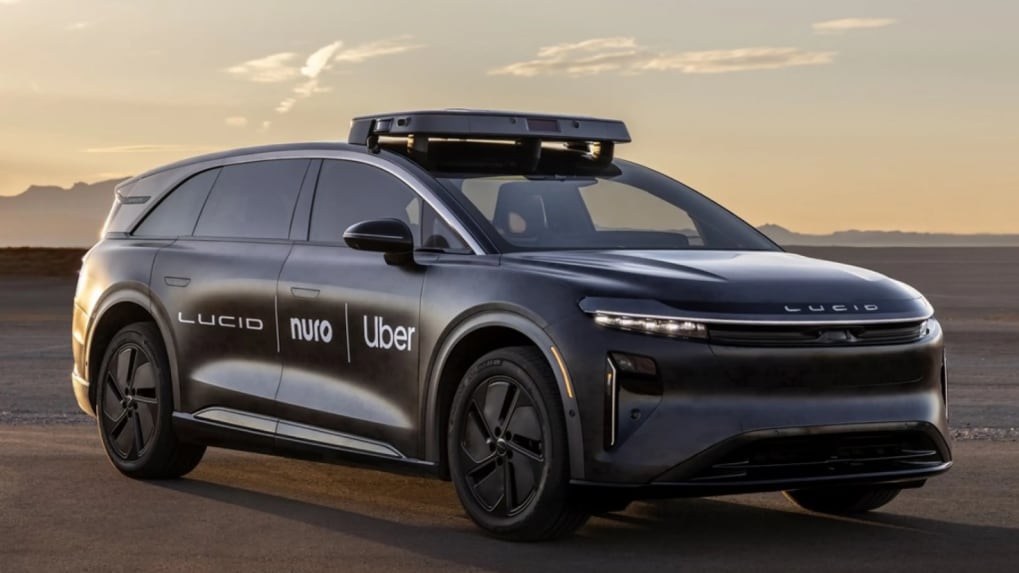
Uber, Lucid Motors and autonomous technology firm Nuro have revealed the production-intent version of their jointly developed robotaxi, marking a key milestone in Uber’s push toward large-scale autonomous ride-hailing, with commercial operations planned for the San Francisco Bay Area later this year.
The vehicle, unveiled at the 2026 Consumer Electronics Show, is based on Lucid’s Gravity electric SUV and represents more than six months of joint development following Uber’s $300 million investment in Lucid and its commitment to purchase 20,000 vehicles from the EV maker. The companies confirmed that the robotaxi is already being tested on public roads as part of final validation efforts.
The autonomous system combines high-resolution cameras, solid-state lidar and radar sensors integrated directly into the vehicle’s body and a roof-mounted “halo.” The computing backbone is Nvidia’s Drive AGX Thor platform, designed to handle real-time perception and decision-making. Integrated LED lighting on the halo helps riders identify their vehicle at pickup locations, mirroring design cues used by other commercial robotaxi services.
Unlike some existing autonomous fleets, the robotaxi’s self-driving hardware is installed during the vehicle’s original assembly at Lucid’s Casa Grande, Arizona factory. This manufacturing approach eliminates the need for post-production retrofitting, reducing costs and speeding up deployment timelines compared with competitors that modify completed vehicles.
At CES, the companies also showcased early versions of the rider interface. Exterior and interior screens are designed to guide passengers through pickup, trip progress and support functions. Inside the cabin, displays show a real-time visualisation of the vehicle navigating city streets, along with journey information, climate and media controls, and quick-access options for assistance or requesting a stop.
Uber has positioned the robotaxi as a premium autonomous service, leveraging the Lucid Gravity’s spacious interior and large-format digital displays. The two-row configuration highlighted at CES prioritises passenger comfort, though a three-row variant is also planned for future deployment.
The launch comes as Lucid works to put earlier production challenges behind it. Software issues during the Gravity SUV’s initial rollout had drawn customer complaints in its first year, but the company says it has since stabilised operations, reporting record sales and a doubling of production volumes in 2024.
Uber, Lucid and Nuro said full-scale production of the robotaxi will begin once validation is completed later this year, with vehicles rolling off Lucid’s Arizona assembly lines. While an exact commercial timeline has not been disclosed, the companies reiterated that the San Francisco Bay Area will be the first market for the autonomous service.
From purpose-driven work and narrative-rich brand films to AI-enabled ideas and creator-led collaborations, the awards reflect the full spectrum of modern creativity.
Read MoreLooking ahead to the close of 2025 and into 2026, Sorrell sees technology platforms as the clear winners. He described them as “nation states in their own right”, with market capitalisations that exceed the GDPs of many countries.