Advertising
From Pink Slips to Silent Sidelining: Inside adland’s layoff and anxiety crisis
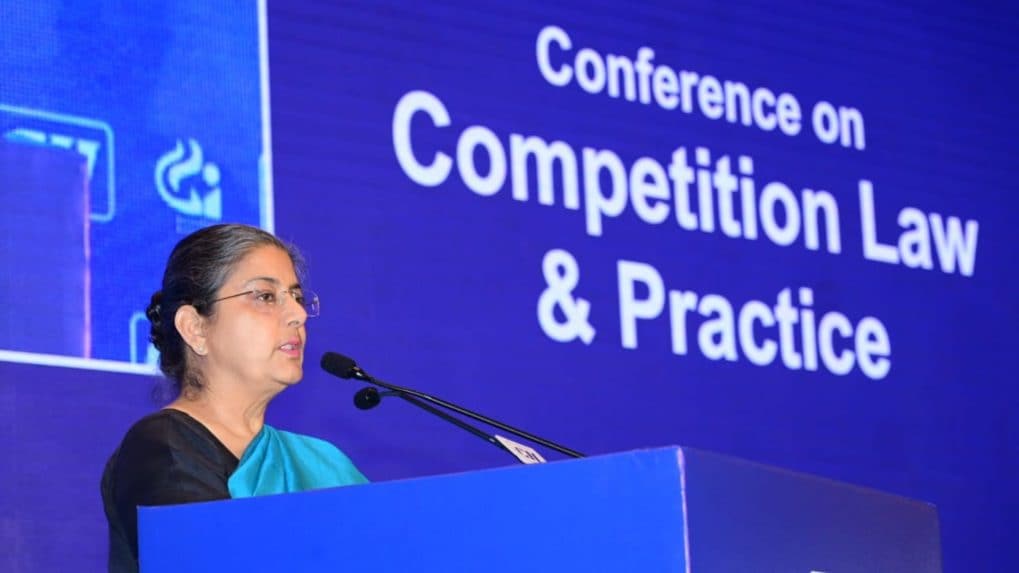
Ravneet Kaur, Chairperson of the Competition Commission of India (CCI), delivered the keynote address at the CII-CCI Conference on Competition Law and Practice in Mumbai, emphasizing the regulator’s evolving approach to digital markets, artificial intelligence, and merger control.
Addressing a gathering of law firms, industry leaders, economists, and policy experts, Kaur underlined the importance of stakeholder dialogue in shaping predictable and fair competition policy. “Dialogue is very important for us,” she noted, adding that its purpose was to understand market realities, ensure regulatory clarity, and promote compliance.
She stressed that all stakeholders share a common responsibility to ensure that markets operate in a fair, transparent, and responsible manner.
Highlighting the rapid transformation of India’s economy, Kaur pointed out that traditional parameters of competition, such as price and output, are no longer the only determinants. “Today, the entire ecosystem revolves around digitalization, technology, and data. These have become the pillars of economic activity,” she remarked.
The CCI, she explained, has been adapting to these shifts with a flexible and balanced approach. While the regulator remains committed to ease of doing business, it will act decisively wherever competition principles are violated. “We do not micromanage markets, but we will intervene definitively when required,” she asserted.
Kaur also elaborated on key features of the Competition Amendment Act, 2023, particularly in the context of merger regulation. A major change, she observed, is the introduction of the “material influence” threshold, which focuses on access to commercially sensitive information rather than merely board representation.
“What matters now is not just how many board seats one holds, but whether there is access to sensitive business information,” she explained, adding that this approach allows the CCI to assess influence more realistically, especially in private equity investments.
Drawing comparisons with global trends, she pointed out that regulators worldwide are becoming more open to merger remedies rather than outright prohibitions. “The developed world is now gradually moving toward an approach that the CCI has followed from the beginning,” she stated, emphasizing that India has historically adopted a flexible and innovation-friendly merger control regime.
Another significant reform, Kaur highlighted, is the introduction of the deal value threshold aimed at capturing strategic acquisitions, including so-called “killer acquisitions.” She indicated that the Commission may review the framework after observing its implementation for over a year. “Now that sufficient time has passed, it may be appropriate to analyze what refinements may be required,” she suggested.
Turning to antitrust enforcement, the CCI Chairperson emphasized the importance of settlement and commitment mechanisms. These, she said, offer a quicker way to correct market distortions without prolonged litigation.
“The best way to achieve market correction is through voluntary commitments by companies,” she observed, adding that the regulator has actively encouraged such resolutions.
She also spoke about the need for clarity on hub-and-spoke cartels, noting that new provisions now explicitly hold intermediaries accountable for anti-competitive conduct and allow them to seek leniency.
A major focus of her address was the growing intersection of artificial intelligence and competition law. Referring to the CCI’s recent market study on AI and competition, Kaur outlined several potential risks, including algorithmic collusion, price discrimination, network effects, and strategic mergers.
“At this stage, we have only identified possible risks. We have not prescribed any regulatory solutions yet,” she clarified.
One of the biggest concerns, she cautioned, is that companies may unknowingly engage in anti-competitive behavior while deploying AI tools. To address this, the Commission is encouraging businesses to undertake internal self-audits.
“Boards and management teams must examine whether AI adoption could result in unintended anti-competitive outcomes,” she advised.
Importantly, Kaur made it clear that responsibility for AI-driven decisions will rest with those using the technology. “The people who use AI tools will be accountable for their impact,” she emphasized.
Reiterating the core philosophy of the Commission, she maintained that consumer welfare remains the ultimate objective of competition enforcement. The CCI, she said, aims to ensure better quality, reasonable prices, and innovative solutions for consumers.
“All our actions are principled, evidence-based, and rooted in sound analytical reasoning,” she affirmed, adding that the Commission is increasingly incorporating effect-based analysis into its decision-making.
Addressing concerns regarding penalties and global turnover calculations, Kaur clarified that there is no arbitrary discretion in the process. “Our penalty guidelines clearly outline aggravating and mitigating factors, ensuring proportionality and logical reasoning,” she explained.
Concluding her address, the CCI Chairperson reiterated the Commission’s openness to industry feedback and collaboration.
“We are very open to hearing suggestions from stakeholders,” she assured, adding that such engagements are essential for ensuring that markets remain competitive and consumer-friendly.
“This shared commitment to fair and free markets ultimately benefits consumers and promotes innovation,” Kaur concluded.
From purpose-driven work and narrative-rich brand films to AI-enabled ideas and creator-led collaborations, the awards reflect the full spectrum of modern creativity.
Read MoreLooking ahead to the close of 2025 and into 2026, Sorrell sees technology platforms as the clear winners. He described them as “nation states in their own right”, with market capitalisations that exceed the GDPs of many countries.