Advertising
From Pink Slips to Silent Sidelining: Inside adland’s layoff and anxiety crisis
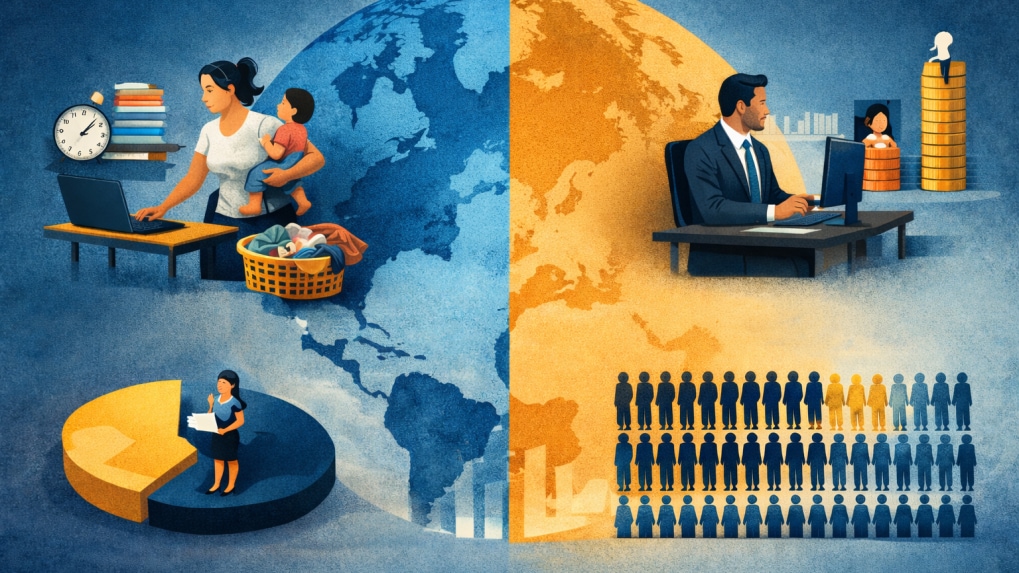
Women work longer hours than men across every region of the world once unpaid domestic labour is included, yet they receive only a fraction of global labour income, according to the World Inequality Report 2026.
The report finds that women contribute a majority of total working hours globally when both paid and unpaid labour are counted, but earn only around 28 per cent of total labour income worldwide. Despite decades of progress in education and labour market participation, no region has achieved gender parity in income or employment.
One of the report’s central findings is the stark imbalance between work and reward. Between 1800 and 2025, average global working hours fell from about 61 hours per week to roughly 40 hours, driven by productivity growth and labour protections. Over the same period, global hourly productivity rose more than 23-fold, from €0.7 to €16.5 per hour. However, the report shows that men have benefited disproportionately from these reductions in formal work hours, while women’s total workload remains high due to unpaid household and care work.
Across all regions, women work more hours than men once unpaid labour is accounted for. In South and Southeast Asia, East Asia and the Middle East and North Africa, women work 12–13 hours more per week than men on average. Even in Europe and North America, the gap remains 6–7 hours per week.
Despite this, women’s share of labour income remains well below equality. In 2025, women earned just 28.2 per cent of global labour income, up marginally from 27.8 per cent in 1990. Regional disparities are stark: women receive only 16 per cent of labour income in the Middle East and North Africa, less than 25 per cent in South and Southeast Asia, and around 40 per cent in Europe and North America, the highest-performing regions in the report.
Employment gaps remain a major driver of inequality. Globally, women are significantly less likely than men to hold paid jobs. In South and Southeast Asia and the Middle East and North Africa, only about 32–34 women are employed for every 100 employed men. In contrast, employment ratios are closer to parity in Europe (89 per 100), North America and Oceania (91) and Russia and Central Asia (93), though none reach full equality.
For women who are employed, pay gaps persist across all regions. The report shows that in 2025, employed women earned on average 71 per cent of men’s earnings globally, up from 69 per cent in 1990. In Sub-Saharan Africa and South and Southeast Asia, women earn just 66 per cent of what men earn. Even in high-income regions such as Europe, North America and East Asia, women’s average earnings remain at around 75 per cent of men’s.
Accounting for unpaid domestic work reveals that inequality is far larger than conventional statistics suggest. In Europe, the gender gap in hourly income rises from 18 per cent when only paid work is considered to 47 per cent once unpaid labour is included. Globally, the “real” gender gap in hourly income exceeds 50 per cent in several regions, including South and Southeast Asia and the Middle East and North Africa.
Education has narrowed some gaps but has not eliminated inequality. Female high-school enrolment globally rose from 88 per cent of male enrolment in 2000 to 98 per cent in 2025, reaching near parity. In high-income countries, female enrolment now exceeds male enrolment. However, the report notes that even where women have equal or higher returns to schooling, they continue to earn less overall due to lower employment rates and wage gaps.
The World Inequality Report 2026 concludes that gender inequality is structural rather than transitional. Without policies that recognise unpaid work, expand childcare and family support, and address discrimination in hiring and pay, economic parity between men and women will remain out of reach.
From purpose-driven work and narrative-rich brand films to AI-enabled ideas and creator-led collaborations, the awards reflect the full spectrum of modern creativity.
Read MoreLooking ahead to the close of 2025 and into 2026, Sorrell sees technology platforms as the clear winners. He described them as “nation states in their own right”, with market capitalisations that exceed the GDPs of many countries.