Advertising
From Pink Slips to Silent Sidelining: Inside adland’s layoff and anxiety crisis
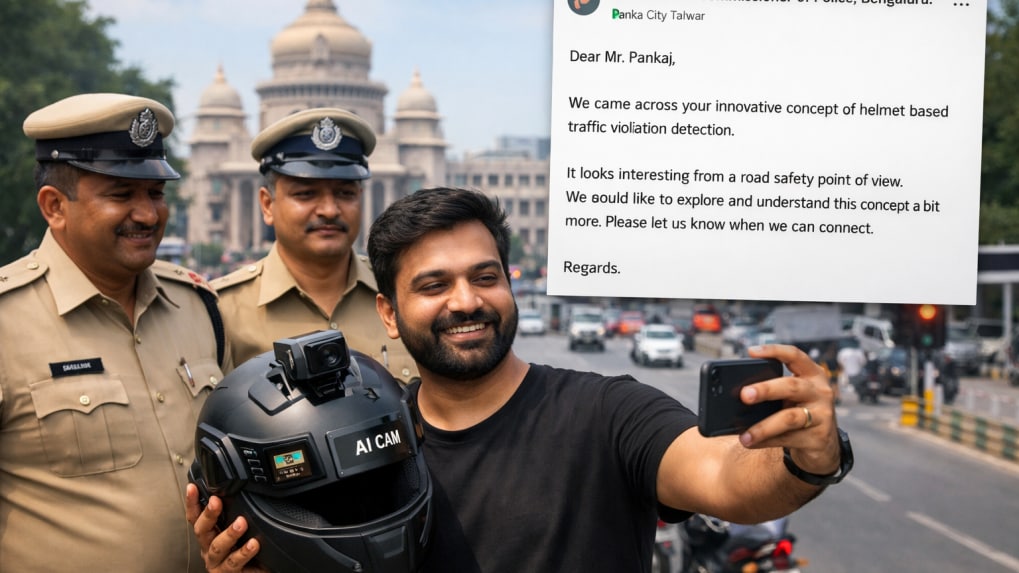
The Bengaluru City Police has contacted software developer Pankaj Tanwar after his AI-enabled helmet, designed to automatically detect traffic violations and alert authorities, went viral on social media over the weekend.
OMG. office of the commissioner of police, blr reached out ???? https://t.co/WywqGXuvj8 pic.twitter.com/jOkOOctWNN
— Pankaj (@the2ndfloorguy) January 4, 2026
Tanwar shared the development on X, posting a screenshot of a message from the Office of the Commissioner of Police, Bengaluru, and writing that the outreach came as a surprise. The city police, through its verified social media handle, later confirmed that it had reviewed Tanwar’s demonstration video and found the concept noteworthy from a road safety standpoint.
In its message, the police described the helmet-based violation detection system as “innovative and interesting,” and expressed interest in understanding how the technology works. The department indicated that it would like to engage further to explore the specifics of the concept and its potential applications.
Also read: Universal Music Group takes minority stake in Farhan Akhtar–Ritesh Sidhwani’s Excel Entertainment
Tanwar’s original post, which has since clocked millions of views, showcased a helmet fitted with a dashcam and a locally running AI agent. The system is capable of identifying traffic violations, extracting vehicle number plates, tagging the time and location, and emailing photographic evidence directly to official traffic police inboxes, all without manual intervention. A clip showing the system instantly flagging a rider without a helmet helped propel the post to widespread visibility.
The viral attention has triggered a mix of praise and debate online. Many users, including entrepreneurs and developers, applauded the idea as a practical use of AI to improve civic enforcement, while others raised concerns around privacy and the implications of citizen-driven surveillance. Actor Kunal Kapoor also weighed in, calling the innovation “brilliant.”
Several users and industry professionals have reached out to Tanwar with suggestions to scale the project, including cloud-based dashcam networks, integration with government platforms such as mParivahan, and even incentive models where citizens receive a share of verified traffic fines. Offers to help refine the hardware and software stack have also surfaced.
Despite the growing interest, Tanwar has maintained that the helmet was built as a personal side project. He described it as a “fun weekend experiment,” consistent with his past work on hardware hacks and local AI and machine learning projects that he regularly documents on his personal blog.
From purpose-driven work and narrative-rich brand films to AI-enabled ideas and creator-led collaborations, the awards reflect the full spectrum of modern creativity.
Read MoreLooking ahead to the close of 2025 and into 2026, Sorrell sees technology platforms as the clear winners. He described them as “nation states in their own right”, with market capitalisations that exceed the GDPs of many countries.