
Welcome to NMIA: The Airport That Makes You Reconsider Home Ownership
Mumbai’s new NMIA airport turns the commute into a journey, with long travel times making flying feel like an afterthought. From canceled flights to bridges becoming tourist spots, the airport challenges how we view travel, commitment, and even our connection to the city.

ADVERTISEMENT
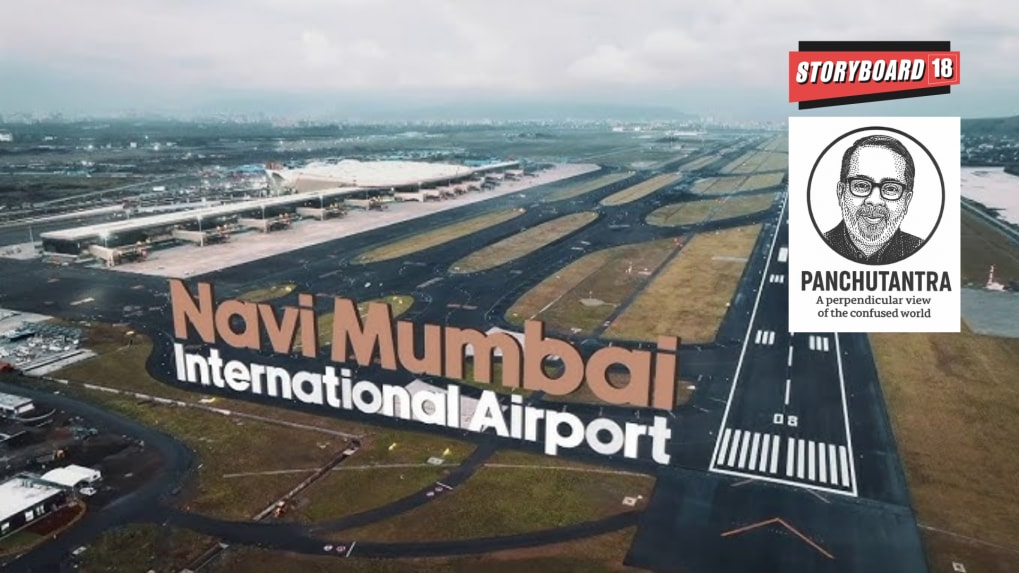
Mumbai has finally cracked a long-standing problem: how to make flying feel like an expedition.
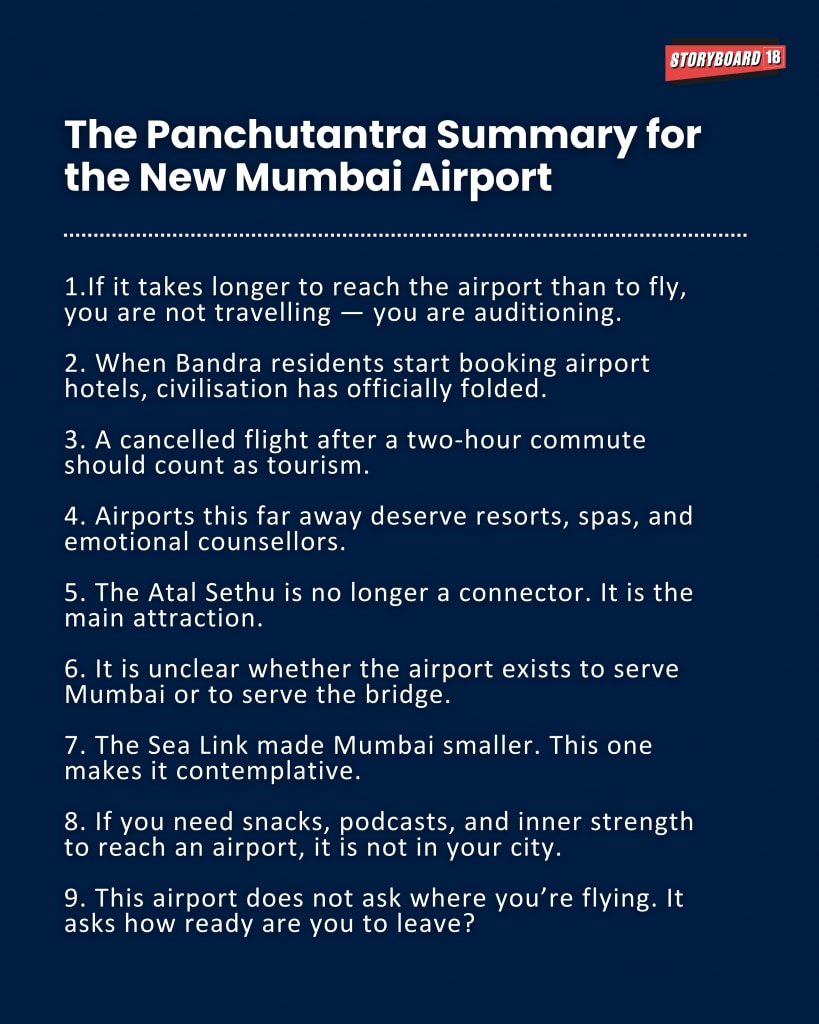
The new airport — which marketing decks confidently label “Mumbai airport” — is not really an airport. It’s a concept. You don’t go there. You prepare. Mentally. Spiritually. With snacks and a backup life plan.
In most cases, it takes about two hours to reach. Often longer than the flight itself. Which is an achievement. This may be the India’s first airport where the commute is the long-haul and the flight is a formality.
Once upon a time, people from cities without airports stayed overnight before flying. Places ending in -pur or -gaon. Families assembled. Luggage was blessed. Dawn was involved.
Now the question is simpler and more disturbing: Will people from Bandra start doing the same?
“Flight at 7 a.m.? Let’s stay near the airport.”
“But the airport is in Mumbai.”
“Yes. But not that Mumbai.”
Soon we’ll see listings: Airport-adjacent sleepovers for Western Suburb residents. Breakfast included. Sanity optional.
Then comes the IndiGo experience. IndiGo will faithfully take you all the way there — across tolls, bridges, optimism, and emotional resilience — and then cancel your flight with a calm blue message.
At which point one must ask: does this count as a day trip?
You’ve travelled for hours, crossed districts, possibly evolved as a person. This is leisure. There should be a refund category called Experiential Cancellation. Or resorts.
Think Lonavala. But with boarding passes. “Come for the airport. Stay for the cancellation.”
Which brings us to the bridge.
The Atal Setu is magnificent. Long. Sweeping. Extremely Instagrammable. It has achieved what few bridges do — it is now the destination. People drive on it not to go somewhere, but to be on it. Like Marine Drive, but with ambition issues.
So a fair question arises:
Is the airport here to justify the bridge?
Or is the bridge here to justify the airport?
There’s also a faint suspicion this may be a branding exercise — to finally make the Atal Setu more famous than the Rajiv Gandhi Sea Link.
The Sea Link was aspirational. It shrank Mumbai. It told Bandra, “You belong.”
The new bridge announces, “You will travel.”
Which leaves the final question: is this airport even in Mumbai?
Administratively, yes.
Emotionally, debatable.
Philosophically, no.
Read More: A Panchutantra lament for classic marketing
It feels less like Mumbai and more like ROM — the Rest of Maharashtra. A place where snacks become essential and your journey acquires chapters.
Mumbai has always believed in efficiency through suffering. Local trains hurt, but they move. Roads are painful, but familiar.
This airport breaks that contract.
It hurts. And then it waits.
Perhaps that is the innovation. Not a terminal, but a mindset. Where flying is no longer about distance, but commitment. Where an airport isn’t infrastructure, but a test of intent. It asks a simple question:
How badly do you really want to leave?
Read More: The HR Training Video Conspiracy: By Panchutantra
Read More: The Panchutantra Manual of surviving a holding company merger