
Brand IndiGo in Turbulence: 1,200+ flights cancelled, shares slide & govt probe sparks unprecedented reputational crisis
With over 1,200 cancellations in late November and early December 2025, on-time performance collapsing to 67.7%, and shares sliding 8%, aviation and brand experts warn India’s largest airline must respond with radical cultural and structural reforms to rebuild trust and prevent long-term reputational damage.

ADVERTISEMENT
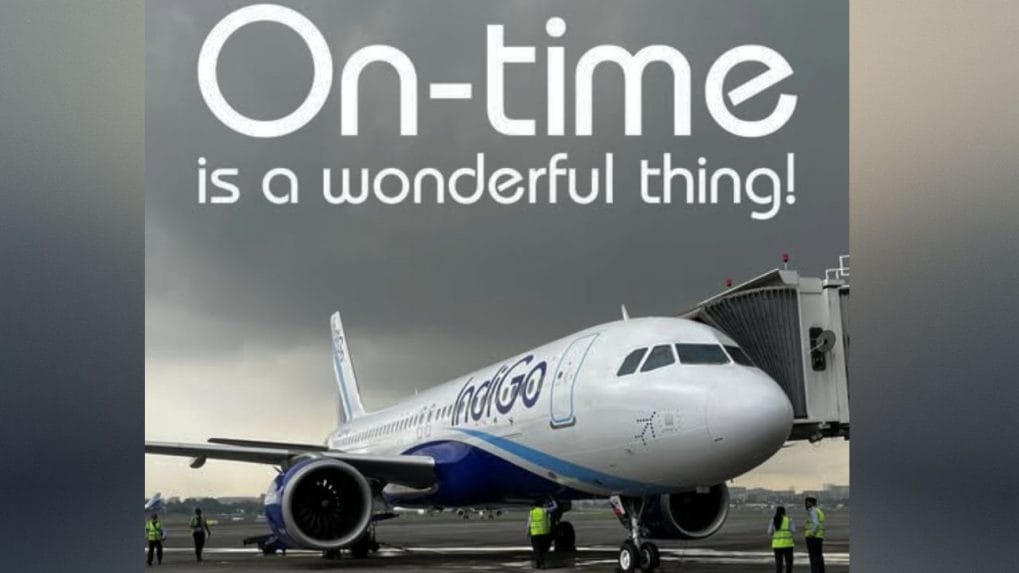
India’s largest airline, IndiGo- long celebrated as the country’s most reliable and punctual carrier, is now battling the biggest operational and reputational crisis in its history. A cascading meltdown driven by crew constraints and the abrupt transition to revised Flight Duty Time Limitation (FDTL) regulations has triggered more than 1,200 flight cancellations in in late November and early December 2025 alone, leaving thousands of passengers stranded, enraged, and scrambling to reroute travel plans.
Simply Speaking: The 6Es that Indigo needs
The airline’s on-time performance, once its proudest marker of differentiation, crashed from 84.1% to 67.7% - a dramatic fall that aviation experts say cuts at the heart of the brand’s promise.
As public frustration surged across airports and social platforms, the Ministry of Civil Aviation stepped in on Friday, announcing a high-level inquiry into the breakdown and mandating immediate passenger relief measures, including automatic refunds, hotel stays for stranded travellers, and priority care for senior citizens and persons with disabilities. The DGCA also temporarily relaxed the new FDTL norms to stabilise staffing shortages- an implicit acknowledgement of the regulatory friction that contributed to the collapse.
Govt launches probe into IndiGo chaos, directs airlines to issue automatic refunds
The crisis has already wiped out significant market value: IndiGo’s stock has fallen over 8% in five days, slipping to its lowest level in five months. While the airline is attempting to restore operations, aviation, communication, and brand experts warn that the damage- both operational and emotional, is far from over.
Brand promise under threat
The reputational risk arising from this disruption is “disproportionately severe” for a company like IndiGo, argues Dr. Vandana Singh, Chairperson, Aviation Cargo at the Federation of Aviation Industry in India (FAII).
“A disruption of this scale directly undermines IndiGo’s reputation as India’s most dependable airline,” she says.
“Passengers chose IndiGo because they believed it wouldn’t fail them. That psychological contract has now weakened.”
Dr. Singh draws parallels to the 2022 Southwest Airlines collapse in the US, where nearly 17,000 flights were cancelled over Christmas due to outdated systems and crew-scheduling failures. “Southwest was only able to regain its footing after acknowledging the failure, investing heavily in system upgrades, and sharing a corrective roadmap publicly,” she notes.
IndiGo’s reputation, she argues, now depends entirely on whether it moves fast, owns the issue, and rebuilds trust with transparency and visible reform.
Brand expert Harish Bijoor puts it even more bluntly. “This is a complete disaster. The airline has not prepared for the change well in advance. It has been reasonably pompous, and enough preparation has not gone into its backend. Built assiduously over decades, the brand is now squandering that equity.”
According to him, customer management has been one of the biggest failures.
“In a crisis, a human wants to talk to a human. IVR systems and AI chatbots don’t cut it. IndiGo must invest in real human support urgently.”
Could IndiGo have prevented the collapse?
A number of experts believe the meltdown was not a sudden blow but a creeping operational stress that leadership failed to act on.
Dr. Singh points out that 755 of the 1,232 cancellations in November were directly related to crew constraints, yet the airline continued full-scale operations. “The data clearly shows stress signals were visible well before the collapse,” she notes.
“Running a full schedule without adequate buffers created the conditions for a cascading network failure.”
Ravi Gosain, President of the Indian Association of Tour Operators (IATO), agrees, “Operational stress never appears overnight, it builds gradually through absenteeism, inadequate rosters, and insufficient manpower planning. Continuing full deployment under strain reflects optimism bias and internal risk signalling failure.”
IndiGo shares drop 8% in five days as crew shortage forces thousands of flight cancellations
He argues that a short-term rollback in schedules or preemptive travel advisories could have blunted the impact rather than detonating it across the network.
“IndiGo’s biggest advantage- scale- became its biggest weakness.”
Where communication collapsed
Crisis communication experts say IndiGo’s silence and lack of visible leadership aggravated the public backlash.
Neha Mohanty, Founder of StarFishGlobal Communications, says, “In aviation, silence creates frustration faster than delays do. Passengers don’t want platitudes, they want updates in real time, clarity on options, and acknowledgement of responsibility.”
She adds that leadership visibility defines crisis perception.
“Passengers experience the outcome, not the intention. IndiGo needed to show its face, not hide behind statements.”
Gosain describes the communication failure in three missing pillars: speed, transparency and empathy. “A crisis plan isn’t PR- it’s customer service. Without it, frustration turns into brand damage.”
The road to recovery: structural and cultural reforms
Experts unanimously agree that IndiGo cannot fix this with surface-level adjustments. The airline must overhaul its internal culture and operational architecture if it is to prevent recurrence.
Dr. Singh outlines key priorities:
- Larger staffing buffers and conservative work-force forecasting
- Advanced roster-planning and disruption-management technology
- Early escalation culture and proactive schedule trimming when pressure rises
- Crew well-being and manpower stabilisation
Gosain recommends a twin model of structural resilience and cultural reset, emphasising predictive staffing using AI and creating independent early-warning systems. He also stresses the importance of rebuilding employee relationships: “Frontline concerns must travel upward without fear.”
IndiGo Flight chaos causes massive surge in train tickets as demand across major routes
Mohanty believes the crisis could become a turning point: “These aren’t headline-grabbing reforms, they’re everyday changes that strengthen foundations. If IndiGo tightens the right screws, it will emerge stronger.”
Bijoor offers a final caution.
“An irritated customer is the worst thing to have. IndiGo has many. The crisis recovery must begin with human customer service and real accountability.”
IndiGo now stands at a crossroads
The government has made its position clear: protecting passengers comes first. The high-level inquiry is expected to diagnose what went wrong, who is responsible, and how this must never happen again.
Whether IndiGo’s current crisis becomes a case study in recovery or a permanent scar will depend entirely on what it does next. The clock that once symbolised punctuality has stopped, and the airline’s credibility is now on borrowed time.
For India’s largest airline, the crisis is no longer operational. It is existential.