
Broadcasting industry pins hopes on 2026 amid policy overhaul and TRAI exit talks
For broadcasting and media CEOs, 2026 is expected to demand both strategic agility and regulatory readiness. Executives say the winning strategy will involve running a dual ecosystem—doubling down on digital-first growth while optimising traditional broadcast where it remains profitable.

ADVERTISEMENT
After years of regulatory flux and policy uncertainty, India’s broadcasting industry is entering 2026 with cautious optimism, betting on long-awaited reforms, a clearer regulatory architecture and a more supportive policy environment to revive growth and investor confidence.
Senior executives across television, radio and digital broadcasting say the coming year could mark a turning point, with the Centre poised to recalibrate oversight, modernise rules and address structural bottlenecks that have weighed on the sector through 2024 and 2025.
The Ministry of Information & Broadcasting (MIB) has formally initiated a proposal to take broadcasting out of the Telecom Regulatory Authority of India’s (TRAI) purview and place it entirely under the ministry. If cleared, the restructuring could be implemented by mid-2026, ending TRAI’s two-decade role in shaping broadcasting policy.
Broadcasters, long at odds with the telecom regulator, see this as a course correction. “There is a broad belief that 2026 will finally bring regulatory stability,” said a senior executive at a large television network. “The sector has been operating under a framework designed for telecom networks, not content-led businesses. A clearer, sector-specific approach is overdue.”
Why the push for change
The friction between broadcasters and TRAI has intensified over the past two years. Industry executives argue that TRAI’s telecom-first philosophy has translated into heavy procedural requirements, rigid caps and prescriptive operational rules that do not reflect the cultural and commercial realities of broadcasting.
Tensions peaked after TRAI issued show-cause notices to more than 250 broadcasters for alleged violations of the 10+2 advertising cap, even though the matter was stayed by the Delhi High Court. “Reopening a sub judice issue was seen as unnecessary and disruptive,” said a senior legal head at a media conglomerate. “That episode strengthened the view, even within government, that the existing regulatory arrangement is misaligned.”
Broadcasters have also raised concerns over TRAI’s proposals to limit audit rights over distributors such as DPOs and MSOs, a move they fear could delay audits by up to 16–20 months. “Timely audits are critical for revenue reconciliation in a market plagued by under-reporting,” said an operations chief at a major network. “Delays weaken broadcasters’ visibility and bargaining power.”
Equally contentious has been the idea of a unified legal framework for telecom and broadcasting. Industry bodies argue that merging carriage and content regulation would blur responsibilities and create compliance uncertainty. “Content cannot be regulated like SIM cards,” said a senior executive at an industry association. “Broadcasting needs a regulator that understands programming, culture and audience behaviour.”
Policy reform agenda for 2026
Beyond regulatory realignment, broadcasters expect 2026 to bring a broader set of policy reforms aimed at modernising the ecosystem. TRAI and the MIB are expected to refine elements of the National Broadcasting Policy, with emphasis on expanding reach, enabling digital transition and introducing more data-driven regulation.
According to people familiar with policy discussions, the focus areas include improved audience and performance measurement frameworks across linear TV, OTT and digital distribution; better coverage goals, particularly for radio and uncovered households; and support for research and development in next-generation broadcasting technologies such as 4K and 5G-enabled transmission.
“There is recognition that measurement and data are at the heart of monetisation,” said a senior media planner. “A more robust, multi-platform measurement system will help broadcasters make a stronger case to advertisers.”
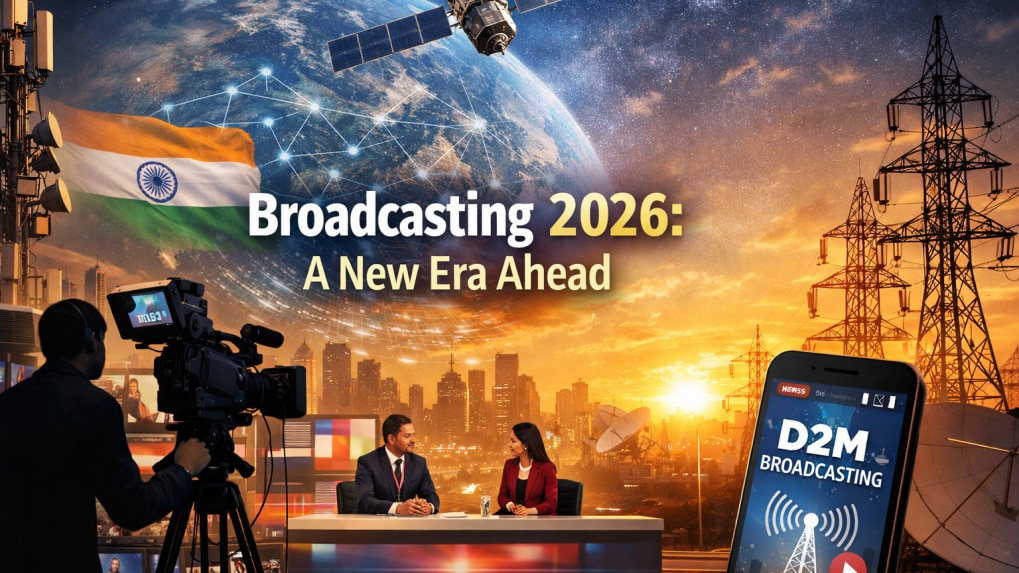
Another area likely to see momentum is the government’s Direct-to-Mobile (D2M) broadcasting initiative, which is slated for rollout in 2026. The technology could allow broadcasters to deliver multimedia content and emergency alerts directly to mobile devices without relying heavily on internet data. Executives say D2M has the potential to expand reach, particularly in rural and low-connectivity regions, and open up new public service and commercial use cases.
A more level playing field
Industry leaders also expect policy refinement around tariff orders and pricing frameworks. While consultations on the New Tariff Order (NTO) are likely to continue, broadcasters are hopeful of more transparent and predictable licensing and pricing norms.
A persistent industry grievance has been the regulatory imbalance between linear television and OTT platforms. Linear TV operates under advertising caps, price controls and mandated audits, while OTT players face significantly lighter oversight, even as both compete for the same viewers and advertising budgets. “We are fighting for the same consumer under completely different rulebooks,” said a strategy head at a top network. “Addressing this asymmetry is critical for the sector’s long-term health.”
From the government’s perspective, the timing of reform is strategic. India’s media ecosystem is undergoing rapid convergence, with bundled services blurring lines between television, broadband and streaming. Distribution models are evolving, margins are under pressure, and global platforms are reshaping consumption patterns.
“The view within the ministry is that a single, domain-focused authority can offer policy stability, faster decision-making and better alignment with global broadcasting norms,” said a senior official involved in internal discussions. “The goal is not deregulation, but smarter regulation.”
What CEOs should expect
For broadcasting and media CEOs, 2026 is expected to demand both strategic agility and regulatory readiness. Executives say the winning strategy will involve running a dual ecosystem—doubling down on digital-first growth while optimising traditional broadcast where it remains profitable.
Content investment, particularly in regional and vernacular markets, is expected to be a key growth lever as localised demand and digital penetration rise. At the same time, companies are being advised to adopt advanced, multi-platform audience measurement tools ahead of regulatory rollouts to strengthen advertising pitches.
On the regulatory front, leaders expect continued consultation and refinement rather than abrupt interventions. “The tone of engagement has improved,” said a senior industry insider. “There is more willingness to listen, and that itself is a positive signal.”
Legal path ahead
One unresolved question is the legal route for removing broadcasting from TRAI’s jurisdiction. Broadcasting was brought under TRAI in 2004 via a government notification interpreting “telecommunication services.” Legal experts say the Centre could either amend the TRAI Act—a cleaner but longer route requiring parliamentary approval—or rescind the original notification, a faster option that could face legal challenge.
“If the government wants a challenge-proof separation, a statutory amendment is the safest approach,” said a senior constitutional lawyer. “But even the fact that this is being actively debated is a sign of seriousness.”
For now, broadcasters are betting that 2026 will deliver what the industry has sought for over a decade: clarity, coherence and a regulatory framework designed for broadcasting rather than telecom. As one senior executive put it, “This isn’t about turf. It’s about fixing a structural mismatch so the sector can grow again.”