

Managers, not companies, are driving Gen Z attrition: Report
Leadership quality and day-to-day management are emerging as the biggest retention risks for employers, according to a new study.

ADVERTISEMENT
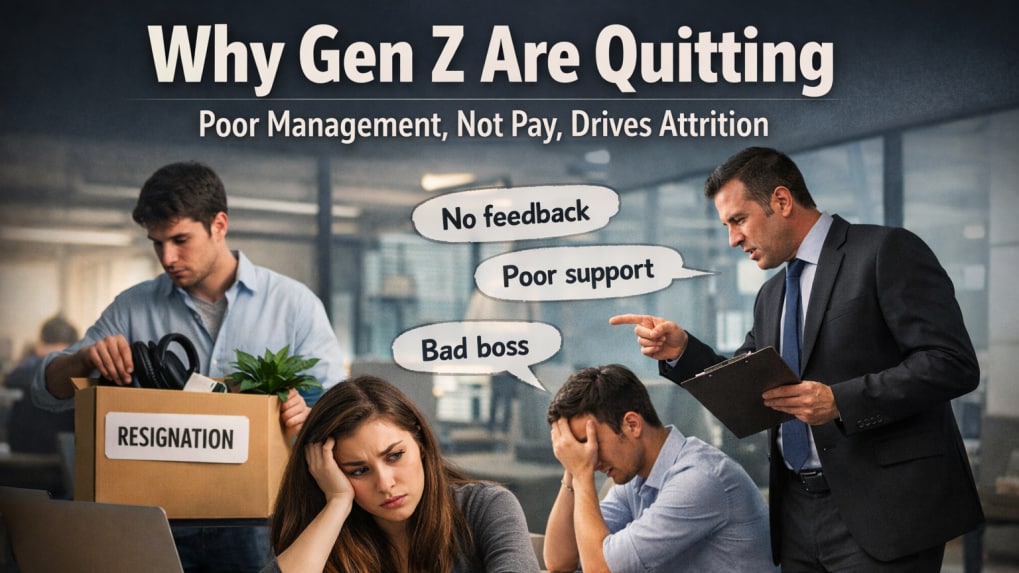
Poor leadership and the absence of regular feedback are emerging as the primary reasons Gen Z employees leave their jobs, overtaking traditional factors such as compensation and workload, according to The Gen Z Work Code Report 2026.
The report suggests that while organisations often focus on company-wide policies, it is the immediate manager–employee relationship that most strongly influences whether young professionals stay or quit. Gen Z respondents consistently flagged lack of support, unclear expectations and minimal engagement from managers as key sources of dissatisfaction.
Also read: As AI reshapes hiring, even Stanford degrees are no longer a guaranteed ticket to top tech jobs
Rather than exiting due to long hours or pay disputes, many Gen Z employees reported disengaging after feeling ignored, undervalued or directionless at work. The report notes that poor communication and irregular feedback cycles contribute to uncertainty around performance, growth and career progression, accelerating attrition.
The findings challenge the common perception that Gen Z workers are primarily driven by external rewards or prone to job-hopping. Instead, the data points to leadership quality as a decisive factor. Respondents indicated that even competitive compensation could not offset the impact of ineffective or inaccessible managers.
The report also highlights that Gen Z expects managers to function as coaches rather than supervisors. Regular check-ins, constructive feedback and transparency around expectations were cited as essential components of a healthy work environment. Where these were absent, employees reported faster burnout and a greater willingness to seek alternative roles.
Also read: Techie’s viral post on 670 job applications sparks debate on how hiring really works
Importantly, the study shows that dissatisfaction is often personalised rather than institutional. Gen Z employees were more likely to attribute negative experiences to specific managers than to the organisation as a whole, underscoring how leadership gaps at the middle-management level can undermine broader retention strategies.
As companies grapple with rising attrition among younger workers, the report suggests that investments in leadership development and feedback culture may deliver higher retention returns than pay revisions alone. Without addressing managerial effectiveness, organisations risk losing talent despite strong employer branding or flexible work policies.
The findings are based on The Gen Z Work Code Report 2026, which analyses evolving workplace expectations and behaviours among Gen Z professionals.