
Election campaigns go big on media, political advertising crosses ₹3,100 crore in FY25
The BJP emerged as the single largest spender by a wide margin, reporting advertising and publicity expenses of ₹2,570 crore in FY25, with ₹1,193 crore spent in 2023-24.

ADVERTISEMENT
Political parties’ advertising and publicity expenditure surged sharply in FY25, reflecting the scale and intensity of electioneering ahead of the 2024 Lok Sabha polls, with the Bharatiya Janata Party (BJP) accounting for an overwhelming share of the media blitz.
According to an analysis of financial statements submitted by political parties to the Election Commission of India (ECI), total spending on advertising, publicity and media-related activities jumped 76% year-on-year to ₹3,124 crore in FY25, compared with ₹1,793 crore in FY24.
The disclosures include expenditure across electronic media, outdoor advertising, digital and social media platforms, print advertisements, media and advertising consultants.
The BJP emerged as the single largest spender by a wide margin, reporting advertising and publicity expenses of ₹2,257 crore in FY25, with ₹1,193 crore spent in the previous financial year. This translated into over 70% of the total political advertising expenditure recorded during the year, underscoring the party’s dominance in campaign communication.
A senior media planner who has worked on multiple national election campaigns said the BJP’s spending reflected a “permanent campaign mode”, with sustained investments across television, digital platforms and large-scale outdoor media. “This was not just about election weeks. The spending suggests year-long narrative-building, high-frequency TV advertising and deep digital targeting across states,” the executive said, requesting anonymity.
The All India Congress Committee (AICC) also significantly stepped up its advertising outlay, reporting expenditure of ₹571 crore in FY25, up from ₹332 crore in FY24, as per its ECI filings. While the increase signals a more aggressive approach to voter outreach, the gap between the Congress and the BJP widened substantially in absolute terms.
A media buying executive familiar with Congress campaigns said the party prioritised digital and regional television channels. “Congress has been selective, focusing on states where contests were tighter, but the difference in spending power compared to the BJP is stark and increasingly visible in media presence,” the executive said.
Regional parties, particularly those contesting high-stakes state elections, also showed sharp spikes in advertising expenditure. The Biju Janata Dal (BJD) increased its spend to ₹112 crore in FY25 from ₹45 crore the previous year, while the Yuvajana Sramika Rythu Congress Party (YSRCP) reported a dramatic jump from under ₹1 crore to nearly ₹90 crore, reflecting an aggressive media push in Andhra Pradesh. The Bharat Rashtra Samithi (BRS) spent ₹72 crore in FY25, lower than its ₹128 crore outlay in FY24 following the Telangana assembly elections.
According to industry executives, the pattern highlights how political advertising has become closely synchronised with state election cycles. Spending spikes are now clearly aligned with election calendars. Parties pour money into television, digital video and outdoor formats in the six to nine months preceding polls.
The AIADMK also sharply raised its advertising spend to ₹42 crore in FY25, compared with just over ₹72 crore in the previous year, while the Aam Aadmi Party (AAP) nearly doubled its expenditure to ₹84.7 crore, continuing its focus on social media-driven campaigns and digital outreach, the filings showed.
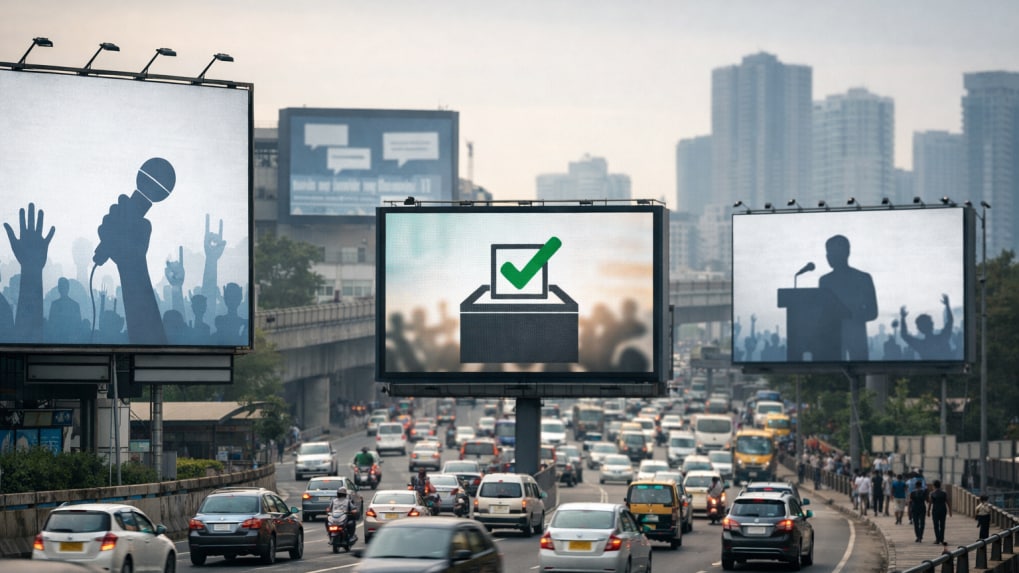
Media experts said television and digital platforms absorbed the bulk of incremental spending, with political parties increasingly deploying high-impact video advertising, targeted social media messaging and influencer amplification. Outdoor advertising, which had seen moderation in non-election years, also made a strong comeback, particularly in urban centres and along major transit corridors.
“Outdoor and transit media have regained relevance because they offer scale and visibility that digital alone cannot deliver, especially in closely fought urban constituencies,” said another senior executive at a media monitoring firm.
At the lower end of the spending spectrum, several national and regional parties reported modest advertising budgets, typically under ₹15 crore, largely focused on local print, limited outdoor visibility and grassroots-level publicity. Parties such as the CPI(M), CPI (ML), Rashtriya Loktantrik Party and smaller state-based outfits maintained lean media operations, according to their ECI disclosures.
The surge in political advertising has translated into a significant windfall for India’s media and advertising ecosystem. Television broadcasters, digital platforms, outdoor media companies and political consulting firms have all benefited from the election-led spending boom, with political advertising emerging as a key revenue driver during FY25.
“Political advertising has become a structural growth segment for media companies rather than a cyclical one,” said a senior broadcast industry executive. “With frequent state elections and an increasingly presidential style of campaigning, this category is only getting bigger.”
With multiple assembly elections scheduled over the next few quarters, industry executives expect political advertising and publicity spending to remain elevated, reinforcing the growing role of money, media and messaging in India’s electoral landscape.