
WPP, Havas, Omnicom: Are advertising’s biggest holdcos recasting agencies as AI Operating Systems?
The CES 2026 launches from WPP, Omnicom and Havas show an ad industry racing to turn human expertise into scalable, compliant AI platforms as pressure mounts on fees, speed and measurable outcomes.

ADVERTISEMENT
For years, the world’s biggest advertising companies treated artificial intelligence as a feature: a faster way to write copy, resize an image, surface an insight. At CES 2026, they began presenting it as infrastructure — the system that will run the agency.
In separate unveilings this week, WPP, Omnicom and Havas each introduced a new layer of software meant to sit above their sprawling networks of agencies, data sets and specialist teams. The branding differed — an “agent hub,” a rebuilt “marketing intelligence platform,” a secure “LLM portal.” The direction did not.
All three are trying to turn what agencies have traditionally sold — judgment, craft, and an ability to connect disparate signals — into productized systems that can be deployed repeatedly, measured more cleanly, and scaled across clients and geographies. In other words: less bespoke alchemy, more operating model.
The new center of gravity: “agentic” work, institutionalized
WPP’s announcement was the most explicit about the wager. It launched Agent Hub inside WPP Open, describing it as an internal app store meant to “codify” decades of proprietary data and best practices into AI agents that can be accessed by clients and its roughly 100,000 employees. The first set of “Super Agents” draws on WPP assets like its Brand Asset Valuator database (about 30 years of brand equity data, according to the company), as well as behavioral-science frameworks from Ogilvy and a “Creative Brain” positioned as a sparring partner for ideation.
The point is not that an AI can brainstorm. The point is that WPP is attempting to package the agency’s collective memory — what used to live in decks, case studies, and senior talent — into tools that are always on, standardized, and governed. WPP says its agents go through a validation process, with emphasis on expert approval, data and privacy compliance, and output quality. It also says WPP Open has more than 75,000 users internally and has been adopted by clients including Nestlé and Coca-Cola.
Havas, for its part, is making a slightly different bet: that agencies will increasingly live in a multi-model world, and the competitive advantage will come from controlling how models are used — securely, consistently and in a way clients will trust. At CES, it outlined AVA, a centralized portal designed to give employees (and eventually clients) secure access to several leading large language models. Havas said AVA is expected to begin rolling out in spring 2026 and is positioned as a compliance-minded gateway — less a single proprietary brain than a controlled switchboard connecting teams to models like OpenAI’s GPT-5, Anthropic’s Claude Opus 4.5 and Google’s Gemini 3.
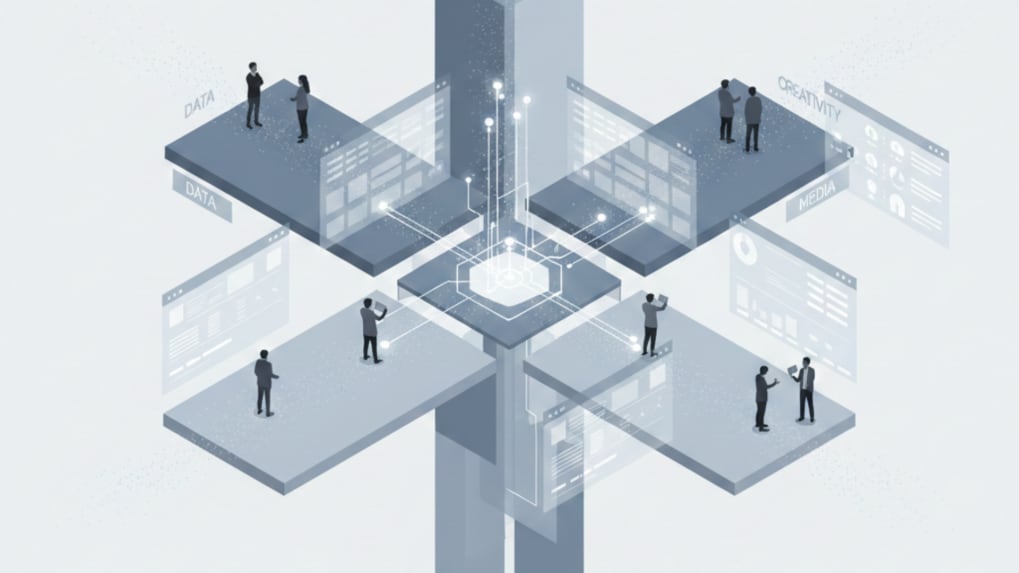
Omnicom’s messaging was the most “enterprise software” of the three — and the most shaped by corporate scale. Omnicom unveiled the next generation of Omni, framing it as a single operating system that unifies strategy, execution and measurement across marketing. It emphasized that the platform is built from the integrated technology and talent of Omnicom and “recently acquired Interpublic,” explicitly naming Acxiom, Flywheel Commerce Cloud and Interact among the assets now inside the system.
The platform’s sales pitch is bigness: Omnicom cited 2.6 billion verified IDs and trillions of signals, alongside $73.5 billion in annual media and commerce buying power. It also described “autonomous agent systems” that orchestrate intelligence across creativity, media, commerce and measurement — a sign that “agentic” language is no longer confined to Silicon Valley product demos.
What these launches are really doing: rewriting the agency contract
These tools are not simply about speeding up production (though Omnicom claims AI-native creative tools can accelerate output). The deeper goal is to change what an agency is — from a set of teams assembled around a client, to a platform that continuously produces work, insights and optimizations.
That matters because the economics of the industry have been under pressure for years: procurement-led fee negotiations, in-housing, the rise of performance marketing, and the growing leverage of platform companies that control the pipes of attention. In that environment, “platformizing” agency expertise offers a way to defend margins and reassert relevance.
WPP all but said so, positioning Agent Hub as a way to deliver “excellence at scale” and explicitly linking it to the idea of commercial models based on outcomes rather than hours.
Omnicom’s version of the same ambition is to collapse the traditional seams — between creative, media, commerce and measurement — into a single workflow, with identity and transaction data at the center. That is also why the Interpublic acquisition is so central to the story: the combination is being sold not only as a bigger holding company, but as a larger data-and-identity apparatus powering a unified system.
Havas’s AVA, meanwhile, reads as a response to a different risk: fragmentation. In a world where clients may have access to the same foundation models as agencies, differentiation shifts to orchestration — governance, model choice, brand safety, and the ability to translate a brief into a repeatable workflow.
The big picture: agencies are trying to become “agent factories”
Put together, these CES launches suggest the large holding companies are converging on the same vision: agencies as managed ecosystems of AI agents, built on proprietary data, wrapped in compliance, and plugged into end-to-end marketing execution.
A few themes stand out:
1) “Operating systems” are replacing point tools. Each company is framing its tech not as a feature but as a foundation — a layer that binds together data, talent and workflows.
2) Proprietary data is the moat they keep pointing to. WPP highlights long-running brand equity data and institutional frameworks. Omnicom foregrounds identity infrastructure via Acxiom RealID and commerce signals via Flywheel. The subtext is clear: the general-purpose models are becoming commodities; the defensible advantage is what you can feed them, and how safely you can deploy them.
3) Scale is being sold as safety. WPP stresses validation and compliance. Havas emphasizes secure centralized access and standards. Omnicom stresses data provenance and “ethically sourced” identity. These aren’t just technical claims — they are meant to reassure global brands that agency AI won’t become a reputational or regulatory hazard.
4) The agency “product” is shifting from deliverables to systems. If these platforms work as advertised, the deliverable is no longer a campaign alone; it is a continuously running machine that proposes creative, allocates spend, learns from performance, and feeds strategy — with humans supervising the highest-stakes choices.
What comes next
The unanswered question is whether clients will pay for this vision as eagerly as agencies are building it. The platforms promise speed, coherence and measurability — but they also raise hard issues: who owns the data exhaust, how “open” these systems truly are, and whether the holding companies can keep talent motivated when more of the craft is embedded into software.
Still, CES 2026 made one thing plain: the ad industry’s largest players are no longer presenting AI as an add-on. They are presenting it as the new center of the business — and racing to ensure that when marketing becomes more automated, the automation runs through their stack.