
Digital grave-robbing or creative tribute?: AI clones Kishore Kumar’s voice, draws millions of views and Ad revenue
Critics argue that recreating the voices of artists who are no longer alive amounts to posthumous exploitation—especially when done without consent from families or estates. Unlike living artists, the dead cannot object, negotiate terms, or protect the integrity of their legacy.

ADVERTISEMENT
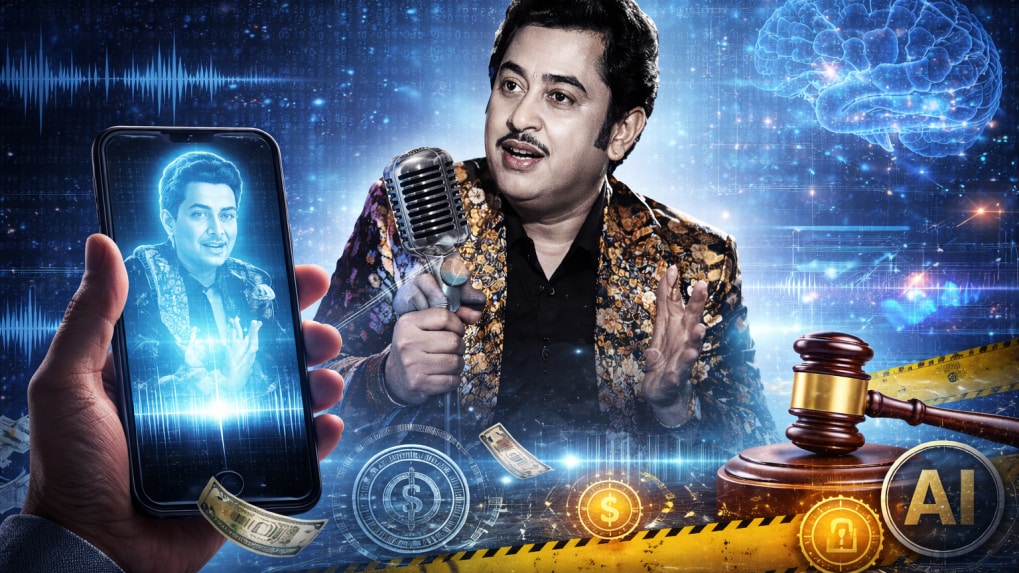
When an AI-altered version of the hit track Saiyaara began circulating online, listeners were startled—not by a remix or a cover, but by a voice. The vocals sounded uncannily like those of Kishore Kumar, one of Hindi cinema’s most revered playback singers, who passed away nearly four decades ago. Within days, the AI-generated track clocked millions of views across streaming and social media platforms, in some cases rivaling the reach of the original song.
The viral moment has reignited a simmering debate in India’s music industry: where does innovation end and exploitation begin?
For veteran singer Shaan, the trend crosses a line. He has described the cloning of legendary voices as “cruel” and “unfair,” arguing that artificial intelligence can replicate pitch and texture, but not the lived experience that shaped an artist’s craft. Comparing AI-generated vocals with original recordings, he says, misses the point entirely. The emotional depth, historical context and human imperfections that made these voices iconic cannot be reverse-engineered by code.
Beyond questions of artistry lies a deeper moral unease. Critics argue that recreating the voices of artists who are no longer alive amounts to posthumous exploitation—especially when done without consent from families or estates. Unlike living artists, the dead cannot object, negotiate terms, or protect the integrity of their legacy. Interestingly, these music pieces have gained over 20-30 million views on YouTube. While it has gained huge traction on other social media platforms which led to generation of huge ad revenues.
Yet some policy experts urge caution against framing the debate as a simple clash between ethics and technology. Kazim Rizvi, Founding Director of public policy think tank The Dialogue, sees the phenomenon as part of a broader creative shift enabled by generative AI.
“The use of AI-generated voices of deceased singers by content creators reflects a broader shift in how creative expression is being enabled by generative technologies,” Rizvi said. “While the trend raises legitimate concerns around consent and legacy, from an innovation perspective, these developments demonstrate AI’s potential to reimagine cultural engagement and creative experimentation.”
According to Rizvi, the solution lies not in banning the technology, but in governing it wisely. “The challenge lies in establishing clear, predictable rules around posthumous rights, and relying on claim-based notice-and-takedown mechanisms so that creativity, tribute, and lawful commercial use can coexist without undermining artistic dignity,” he said.
That lack of clarity is the major problem. Dhruv Garg, founding partner at the Indian Governance and Policy Project (IGAP), points out that India’s intellectual property regime does not explicitly recognise personality or publicity rights. While Indian courts have, over time, extended limited protection to living celebrities against the misuse of their likeness, mannerisms and voice, that protection weakens significantly after death.
“In India, personality rights linked to likeness and attributes may not survive the death of a celebrity, except perhaps in limited cases involving well-known names,” Garg said. “Protecting a singer’s voice posthumously will be a challenge, and it remains to be seen how courts will deal with this issue at scale.”
In the absence of statutory safeguards, AI-generated tracks continue to proliferate on digital platforms—often without licensing, attribution or revenue sharing. This creates a commercial imbalance: original artists, composers and rights holders receive no compensation when AI versions generate millions of streams, while platforms struggle to identify what is legitimate content and what is synthetic impersonation.
For Advocate (Dr.) Prashant Mali, a cyber and AI laws expert, the consequences go beyond legal ambiguity. “This trend is not creativity—it is digital grave-robbing,” he said. “Recreating the voice of a legend like Kishore Kumar using AI without consent or licence converts legacy into a commodity. It erodes artistic dignity and monetises a reputation the creator can no longer defend.”
Mali argues for mandatory licensing frameworks, watermarking of AI-generated voices, and platform-level liability for hosting unverified synthetic content. He also calls for courts to treat unauthorised AI voice cloning as commercial exploitation rather than dismissing it as fan tribute. “Personality rights should not die with the person,” he said, adding that such rights should either vest with legal heirs or be protected as part of India’s cultural heritage.
There are also cultural risks. Experts warn that younger audiences—less familiar with original recordings—may begin to associate AI-generated performances with real artists, blurring the boundary between historical authenticity and algorithmic simulation. Over time, this could distort collective memory and reshape how musical legacies are understood.
India, meanwhile, continues to lag behind several developed markets in AI governance, particularly around creative content, deepfakes and digital impersonation. As Rizvi notes, while living celebrities can actively license and enforce control over their name, image and voice, deceased personalities depend on heirs or estates to assert these rights—often through evolving judicial interpretations rather than clear statutes.
The debate over AI-generated songs in the voices of India’s musical legends ultimately reflects a larger reckoning. As technology accelerates faster than the law, the music industry finds itself navigating uncharted territory—trying to balance innovation with respect, experimentation with consent, and progress with preservation.
How India answers these questions will not only shape the future of AI governance, but also determine how the country chooses to honour the voices that defined its musical soul.