

What is perfect February? Why February 2026 has the internet obsessed
February 2026 is drawing unusual attention online for a rare calendar alignment that creates four complete weeks, a phenomenon calendar enthusiasts call ‘Perfect February’

ADVERTISEMENT
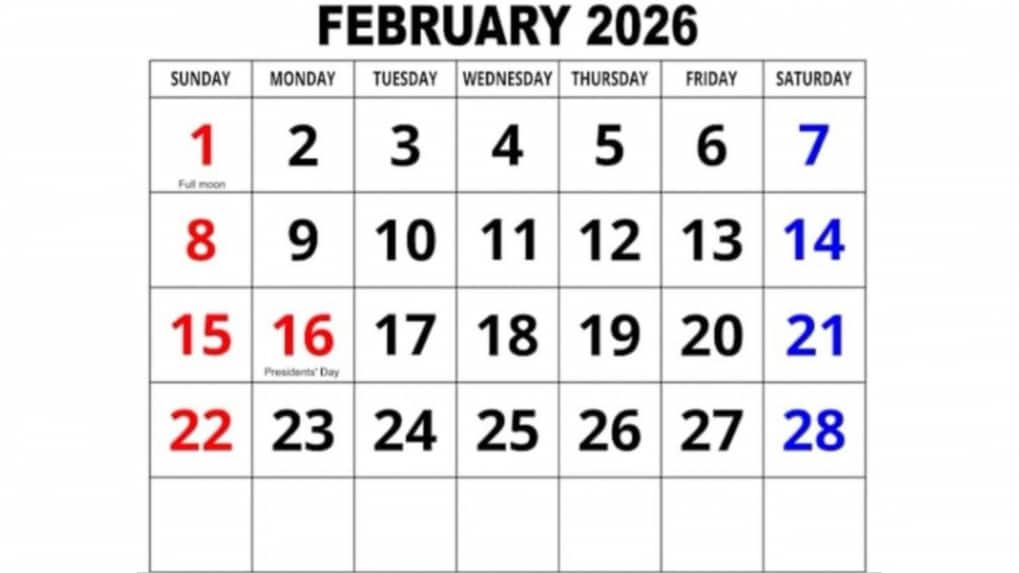
As 2026 begins, an unusual quirk of the Gregorian calendar is drawing widespread attention online. February this year will display what many are calling a “Perfect February,” a rare alignment in which the entire month fits neatly into four complete weeks.
February 2026 has 28 days and begins on a Sunday, ending on a Saturday. This creates a calendar where each weekday appears exactly four times, with no dates spilling into a fifth row. While mathematically straightforward, the visual symmetry is uncommon enough to spark renewed interest each time it occurs.
The trend gained traction after a post on X highlighted the structure of the month. One user pointed out that February 2026 will have four Sundays through four Saturdays, noting that such an alignment “will likely happen rarely again.” The post was accompanied by a calendar image showing the evenly distributed dates.
This coming February 2026 will likely happen rarely again.
— Sandip Nayak (@IamSandipNayak) January 4, 2026
This coming February will have:
• 4 Sundays
• 4 Mondays
• 4 Tuesdays
• 4 Wednesdays
• 4 Thursdays
• 4 Fridays, and
• 4 Saturdays.
February starts perfectly on Sunday and ends on Saturday pic.twitter.com/DMajVY4IyV
Another post that helped push the topic into wider conversation explained why the month stands out. A different user noted that because 2026 is not a leap year, February contains exactly 28 days, forming “a neat block of four complete weeks with no spillover dates.” The alignment was described as “oddly satisfying,” a sentiment echoed by many users sharing screenshots of their calendars.
Also read: Why Tomorrowland is trending on Google: Asia’s first full edition announced for Thailand
The structure itself is a result of how the Gregorian calendar handles leap years and weekday progression. A 28-day February starting on a Sunday automatically creates a uniform four-week grid. While this configuration has occurred before, most recently in 2015, it does not repeat annually due to the shifting calendar cycle.
It is also worth noting that the “perfect” symmetry is not universally visible. The layout only appears this way in regions where Sunday is considered the first day of the week. In countries where calendars begin on Monday, the same month does not produce the same visual balance.
With screenshots and explanations circulating widely, February 2026 has become a small but notable reminder of how even routine systems like calendars can capture public imagination when rare patterns emerge.
Also read: Music events are influencing how India’s Gen Z plans travel, Airbnb data shows