
Brands bet big on movies for TV co-branding, clocking 570+ hours in 2025: TAM
General Entertainment Channels (GECs) and News channels emerged as the two most dominant television genres for advertisers in 2025, together accounting for 56% of total TV ad volumes.

ADVERTISEMENT
Co-branded advertising on television, particularly brand partnerships with movies, continued to gain traction in 2025 as advertisers increasingly aligned themselves with high-impact entertainment properties to enhance visibility and consumer recall, according to the latest TAM AdEx Television Advertising Recap 2025.
Brands and film studios together clocked over 570 hours of co-branded television advertising during the year, highlighting how cinematic collaborations have become a mainstream strategy within the TV advertising ecosystem.
Big-ticket films power brand alliances
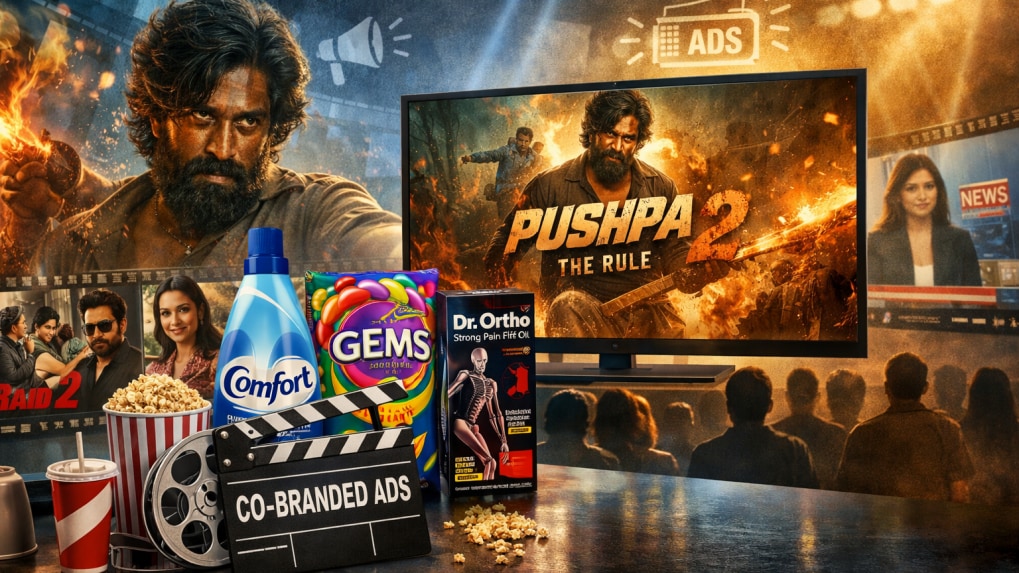
Among movie-linked campaigns, brands associated with ‘Pushpa 2’ accounted for 23% of total co-branded ad volumes in 2025, underlining the strong pull of large-scale film franchises for advertisers seeking mass reach.
Comfort Fabric Conditioner emerged as the leading brand in movie co-branding with a 23% share, followed by Cadbury Gems at 18% and Dr Ortho Strong Oil at 8%. Dr Ortho Strong Oil stood out for its multi-film strategy, partnering with five movies during the year, including Raid 2, to build sustained on-screen presence.
Nearly 60 films partnered with brands on television in 2025. 120 Bahadur led with seven brand tie-ups, while Fateh followed with six. Films such as Ground Zero, Mere Husband Ki Biwi, De Pyaar De 2 and Jolly LLB 3 also featured prominently, each collaborating with five advertisers.
Media planners say movie-led co-branding enables brands to borrow equity from film narratives and stars, creating stronger emotional connect with audiences compared to standalone commercials.
GECs and News channels dominate ad exposure
General Entertainment Channels (GECs) and News channels emerged as the two most dominant television genres for advertisers in 2025, together accounting for 56% of total TV ad volumes.
GECs alone commanded a 30% share, maintaining their position as the single largest advertising genre. With high viewership across daily soaps, reality shows and movie premieres, GECs continued to attract FMCG advertisers seeking consistent reach and frequency. Movie-linked co-branded campaigns, in particular, found strong visibility around film telecasts and prime-time entertainment programming.
News channels followed closely with a 26% share, reflecting their continued relevance as appointment-viewing platforms during major national, political and sporting events. Advertisers across FMCG, services and financial categories leveraged news channels for rapid reach amplification and contextual relevance, especially for topical or credibility-driven messaging.
Media planners note that while GECs deliver scale and emotional engagement, News channels offer immediacy and impact, making the two genres complementary pillars in television media plans.
FMCG brands anchor TV advertising
Beyond co-branding, FMCG continued to anchor television advertising activity. Food & Beverages led all sectors with a 21% share of ad volumes, followed by Personal Care/Personal Hygiene at 15% and Services at 14%.
At the category level, Toilet Soaps and Toilet/Floor Cleaners remained the most advertised segments, reflecting sustained investments by marketers in high-penetration, everyday-use products. Retail Outlets–Jewellers also saw a notable rise in visibility, moving into the top 10 categories in 2025.
Hindustan Unilever retained its position as the largest television advertiser with a 14% share, while Reckitt Benckiser (India) strengthened its dominance with seven brands featuring among the top 10 most advertised brands.
Among individual brands, Dettol Toilet Soaps, Harpic Power Plus, and Dettol Antiseptic Liquid led the rankings, underlining the continued strength of hygiene and home care portfolios on television.