
Global merger, local turmoil: Omnicom–IPG merger triggers leadership unease
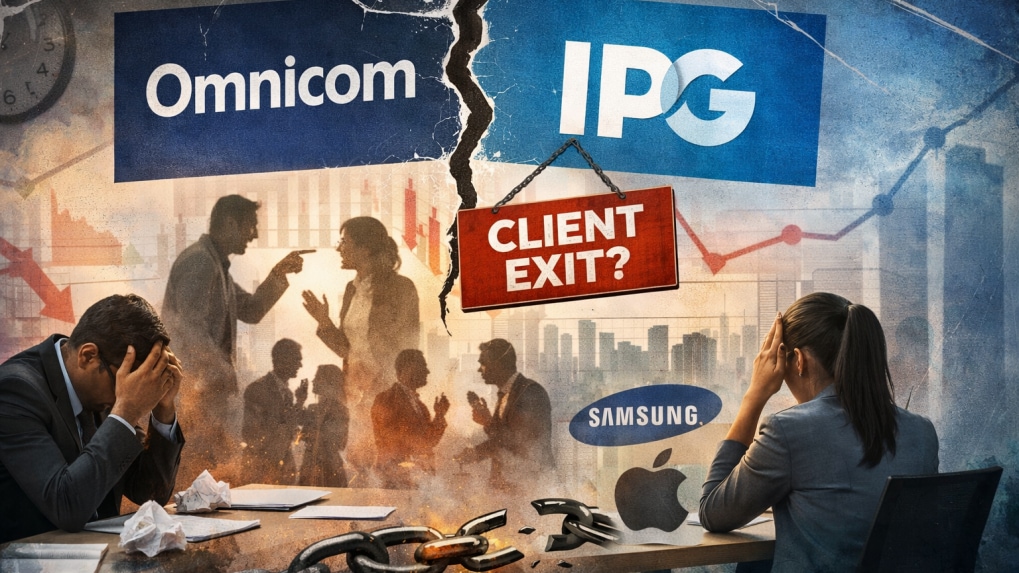
The Omnicom–IPG merger is triggering leadership unease, organisational churn, and growing client reassessment in India, raising questions about whether global consolidation is weakening a once-stable local franchise.

ADVERTISEMENT
The global consolidation of Omnicom Group and Interpublic Group (IPG) is beginning to cast a long shadow over their India operations, with multiple industry sources pointing to growing leadership dissatisfaction, client unease, and organisational instability at Omnicom Advertising India.
According to several senior executives familiar with the matter, the integration has failed to deliver clarity or momentum in the Indian market, instead triggering internal friction at the highest levels. Even top leadership, including Dheeraj Sinha — CEO of McCann Worldgroup India — is understood to be unhappy with how the post-merger structure is evolving. Sinha previously led the IPG-owned FCB which was folded into McCann. Meanwhile, Prasoon Joshi who led McCann in India and APAC was named chairman of Omnicom Advertising India.
The leadership structure strictly passes through Sean Donovan, Omnicom Advertising Asia President with Aditya Kanthy, President and Managing Director Omnicom Advertising India. While Kartik Sharma, CEO of Omnicom Media India reporting into APAC chief executive Tony Harradine.
A leading client of Omnicom Advertising India who is likely to review the account stated, "There’s visible leadership unease, and we can sense it. Turnaround times have stretched, solutions feel less customised, and confidence has taken a hit. We’re not exiting immediately, but we are definitely reassessing what ‘business as usual’ means.”
Industry insiders cite a lack of autonomy, overly complex reporting structures, and reduced flexibility in crafting client solutions as the primary pain points. “Earlier, India leadership had real decision-making power. Now, everything seems to require multiple global approvals,” said a senior agency executive who has worked closely with Omnicom clients. “It has slowed responses, diluted accountability, and created confusion both internally and externally.”
Another leading executive told Storyboard18, “Any merger where leadership spends more time managing internal reporting lines than solving client problems is bound to wobble. In Omnicom’s case, the loss of local autonomy has clearly slowed decision-making, and that kind of drag shows up very quickly in client satisfaction.”
Omnicom Advertising India did not comment.
Structural Chaos and Office Shifts
The organisational uncertainty is playing out not just in reporting lines, but also in physical restructuring. Multiple sources indicate that the McCann leadership team is likely to shift along with Ulka to Omnicom House in Santacruz from their original location at Voltas House in Chinchpokli, while Lintas will continue to operate from its Bandra Kurla Complex (BKC) office.
Meanwhile, Omnicom Media India is expected to relocate to Chibber House in Saki Naka, though sources caution that final decisions are still evolving. “There is no clear narrative on why these moves are happening or how they align with a broader strategy,” said a former Omnicom executive. “People are hearing things in fragments, which only adds to anxiety.”
Global Merger, Local Fallout
The unease in India mirrors concerns voiced globally about the Omnicom–IPG merger, but industry veterans believe the impact is sharper in markets like India where IPG historically enjoyed strong equity.
Sir Martin Sorrell, Founder of Monks and Executive Chairman of S4 Capital, recently told Storyboard18 that the lack of communication around the merger is already unsettling clients. “Many feel they haven’t been adequately briefed on what the merger means for their accounts. So there will be a lot of discombobulation,” Sorrell said, adding that 2026 would be the first real test year for the combined entity.
“India is a good example because IPG has been relatively strong here, with established creative and media brands,” Sorrell noted. “Now, with Omnicom clearly the dominant partner, there is concern about whether IPG leadership and talent are being sidelined, and how that affects continuity.”
That concern is echoed by analysts tracking the advertising sector. “Whenever a ‘merger of equals’ plays out as a dominance-led integration, morale suffers,” said an independent media analyst. “Talent flight becomes a real risk, especially in India where senior leaders have strong external options.”
Clients Begin to Reassess
Perhaps the most worrying signal for Omnicom Advertising India is emerging client behaviour. Sorrell warned that perceived instability often pushes clients to explore alternatives. “When clients sense internal instability—people leaving, reporting lines changing, brands being folded or renamed—they naturally start to explore alternatives,” he said.
That trend may already be underway. Samsung India has recently initiated a multi-agency media pitch for its estimated ₹300-crore advertising mandate, a move widely linked to concerns arising from the global Omnicom–IPG merger. The consolidation has reportedly thrown up potential conflict-of-interest issues involving Apple — Samsung’s biggest global rival — prompting the Korean electronics major to reassess its long-standing media agency relationships in India.
A rival holding company executive described the situation bluntly: “This merger has handed competitors a talking point on a platter. Clients are nervous, and nervous clients listen.”
Competitive Pressure Mounts
Rival networks are already circling, positioning themselves as more stable and conflict-free alternatives. “When leadership itself appears uncertain, it becomes very hard to sell confidence to clients,” said a senior executive at a competing global agency group. “India is too important a market for this kind of prolonged ambiguity.”
While Omnicom globally has maintained that the IPG integration will unlock efficiencies and scale, the Indian experience so far suggests a rockier road ahead. With leadership morale under strain, clients increasingly restless, and internal clarity still elusive, the merger that promised strength through consolidation risks becoming a case study in how global decisions can destabilise strong local franchises.