
How client–agency relationship still existing, just without trust
As brands in-house, AI scales content and speed trumps craft, India’s agency business stands at a brutal inflection point: evolve into judgment-led growth partners or be reduced to commoditised execution vendors.

ADVERTISEMENT
For decades, advertising agencies thrived on a simple promise: they would think, create and execute better than anyone else. Today, that promise is under siege.
Brands are building in-house teams at record speed. SaaS platforms and AI-led marketing stacks can now generate, distribute and optimise content faster than most agencies ever could. Performance dashboards update in real time. Attribution models demand instant accountability. And clients, under relentless business pressure, are asking an uncomfortable question: What exactly are we paying agencies for?
The fear stalking the industry is clear: are agencies being pushed down the value chain, reduced to execution partners while technology and consulting firms own strategy?
How ad holdcos consolidation pulling advertising away from creativity and towards media math
According to independent creative consultant Soumitra Karnik, the danger is not just real, it is self-inflicted.
“Agencies are at risk of being reduced to execution partners and in many cases, the industry is willingly rolling out the red carpet for its own funeral,” he says.
“The problem is not in-housing, SaaS or AI. Those are just tools. The real issue is identity loss.”
The Panic to Become Everything
Karnik’s critique cuts to the heart of large network agencies. In their rush to appear future-ready, many have chased consulting, data, performance, platforms and automation, often all at once.
“Network agencies are too busy chasing every curveball,” he says. “Every new CEO comes with new mumbo-jumbo instead of sustaining the organisation’s culture and evolving within it. In that process, they give up their core strength.”
Ad Agencies in Crisis: Brands demand 25% fee cuts as AI wipes out timelines and costs
The result, he argues, is factory-like thinking, where speed and scale matter more than judgment and meaning.
“When agencies stop asking what should be said and only focus on how fast it can be produced, they surrender their role.”
This is where AI becomes misunderstood. Automation is not the enemy, Karnik insists. Abdication is.
“Agencies that try to win by becoming always-on execution engines will eventually lose to software. Every new version of software will always be faster, cheaper and better.”
Why Strategy Still Can’t Be Automated
Mehul Gupta, co-founder and CEO of SoCheers, echoes this sentiment. Tools may be powerful, but they are deeply limited where it matters most.
“SaaS, AI and in-house teams are fantastic at speed, but terrible at judgment,” he says. “They often operate with inherent bias.”
For Gupta, the future agency is neither a nostalgic AOR nor a content factory. It is an expert brain, trained in culture, platforms and human behaviour.
“Strategy, when done right, can never be automated,” he says. “Stagnation comes from sameness. Agencies exist precisely because they break that sameness.”
Recent mega-mergers and restructuring across global networks, he adds, have only amplified the need for agencies to act as marketing purveyors, not asset-shipping vendors.
The In-Housing Reality Check
The rise of in-house agencies has undeniably hit traditional revenue models. But Abhik Santara, CEO and director of ^atom network sees this not as an extinction event, but a correction.
“Brands that rushed to build in-house agencies quickly discovered the limits of that model,” he says. “The inability to attract strong creative leadership led to content-heavy marketing divorced from brand thinking.”
The outcome? Many brands are returning to agencies, not for volume, but for depth.
“They’re coming back for high-impact, strategic projects where brand imagination truly matters,” Santara explains.
Steady Agencies > Big Networks : Marketers push back as agency turmoil threatens brand continuity
At the same time, a new class of marketing platforms, focused on distribution, personalisation and performance has scaled rapidly.
“These platforms are not competitors to brand thinking. They are amplifiers of it.”
The real winners, Santara argues, will be those who can combine imagination with technological reach.
When Trust Breaks, Everything Breaks
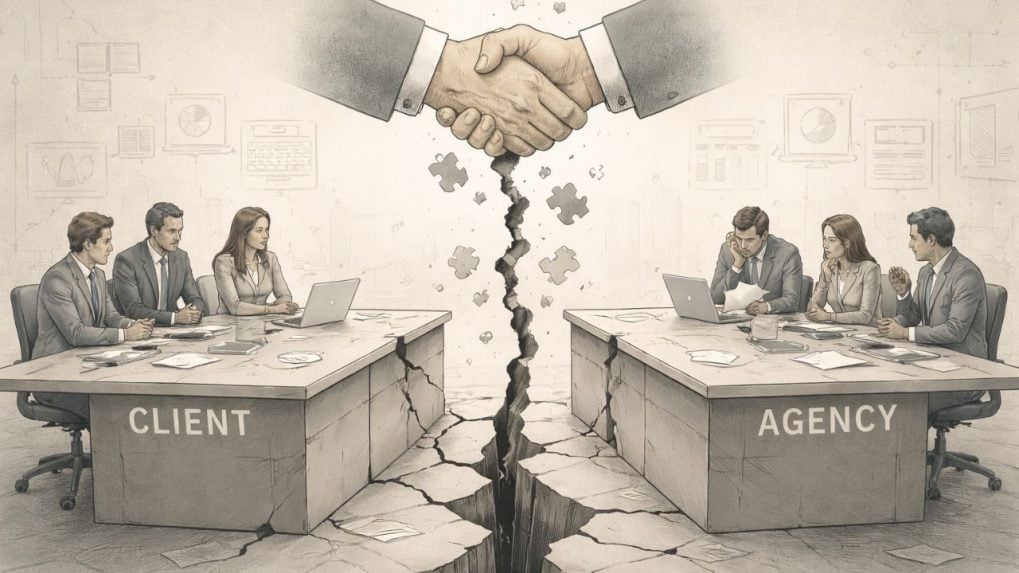
If strategy is under threat, the agency-client relationship itself may be even more fragile.
Karnik describes a familiar, dysfunctional ritual: “I’ve been in meetings where fifteen people from the agency meet three from the client. Out of those fifteen, actual work is done by a handful. From the client’s perspective, this feels like excess cost with no clear value.”
Once that perception sets in, the relationship shifts. Clients stop asking for better thinking and start demanding faster output. Scope creep follows. Partnerships turn transactional.
“In such a system, pitches become a charade, retainers feel unjustifiable, and output-based pricing takes over. From that point, it’s a race to the bottom.”
Gupta agrees, and warns that pricing is not the first casualty.
“Not pricing, but trust is the first thing that will collapse,” he says. “Endless pitching and scope creep are symptoms of misalignment.”
From Pink Slips to Silent Sidelining: Inside adland’s layoff and anxiety crisis
His prescription is clear: modular, accountable engagements with finite experiments and measurable impact.
“Agencies should stop auditioning forever. Clients should stop mistaking volume for value.”
The Output Trap
One of the most dangerous myths gripping the industry is that more output equals more value.
Santara is blunt about where this leads: “When quantity becomes the metric, agencies optimise for speed instead of substance. Average talent produces average work for average fees, and a vicious cycle begins.”
AI has only accelerated this trap. Content generation is now table stakes.
“The agencies that are actually winning aren’t the ones using AI the most,” he says. “They’re the ones applying judgment.”
From Heroics to Systems
Most leaders agree the core problem is not talent or fees but a servicing model built for a slower, linear era.
“The human-dense agency structure was designed for a time when work moved slowly and predictably,” Karnik says. “On all three counts—speed, hours, output—software will always outpace us.”
The model must flip.
“From ‘pay us for how much we do’ to ‘pay us because we know what not to do.’”
Vishal Singh, VP–Agency and Brand Partnerships at Globale Media, frames the shift in operational terms.
“Today’s growth demands system-led marketing, not people-dependent heroics,” he says. “Agencies must scale by adding intelligence, not headcount.”
That means repeatable frameworks, automation where it makes sense, and strategic judgment where it matters most.
“The agencies that survive will redesign themselves not as service providers, but as operating partners for growth.”
Why Independents Are Pulling Ahead
Across voices, one pattern stands out: independent agencies are punching above their weight.
“They are smarter, braver, faster and more adaptable,” Karnik says. “They haven’t lost sight of who they are.”
Santara agrees, warning that large networks often dilute value by trying to be everything.
“You can’t expect a plumber and a painter to collaborate seamlessly just because they’re in the same building,” he says. “Too many agencies chase revenue instead of charging a premium for what they truly do best.”
Without a strong creative culture, he adds, creativity becomes a hollow promise.
The Relationship Still Matters
Kanika from Cheil X brings a quieter but crucial perspective: amid speed, fragmentation and performance pressure, the agency business remains deeply human.
“We are fundamentally in the business of people and relationships,” she says. “Not everything can be overnight, and not everything needs weeks.”
The future, she argues, lies in discernment—knowing when speed is required and when craft needs space.
“That distinction comes from conversation, not assumption.”
The Real Choice Ahead
The agency business is not being killed by AI, in-housing or SaaS. It is being tested.
Agencies can chase volume, optimise for speed and compete with machines or they can reclaim what machines cannot replace: judgment, cultural intelligence and the courage to say no.
Karnik sums it up, “A truly efficient agency does not scale by producing more work. It scales by making fewer and better decisions, early.”
Inside India’s 2026 Media Pitches: How Omnicom–IPG will be tested beyond scale
In an industry addicted to output, that may be the most radical idea of all.