

This Republic Day, a Karnataka tech team wants to take the Indian flag to the edge of space
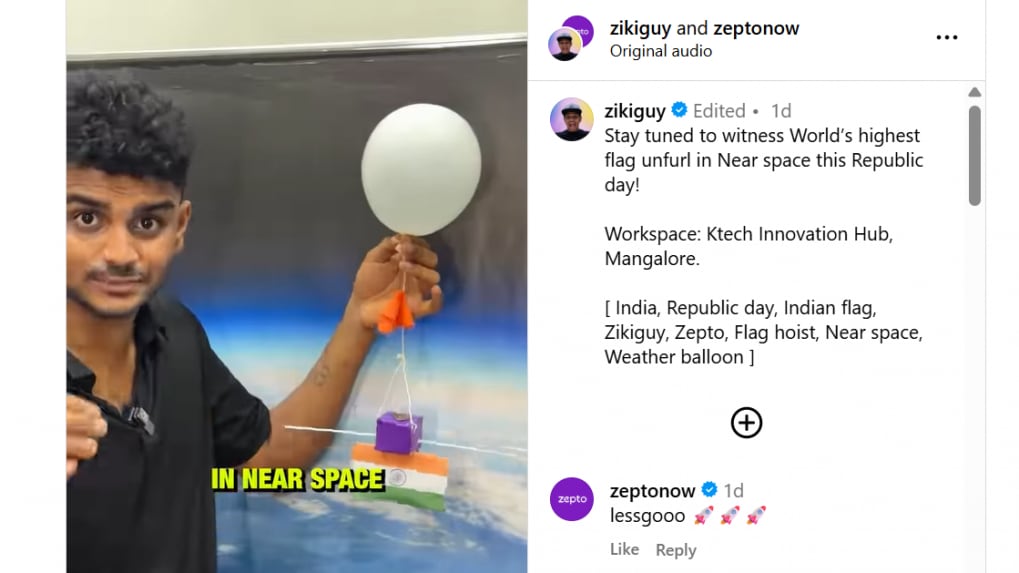
A group of technology enthusiasts from Karnataka is planning to hoist the Indian national flag close to the edge of space using a hydrogen-filled high-altitude balloon, marking Republic Day with an experimental near-space mission.

ADVERTISEMENT
As India prepares to celebrate its 77th Republic Day, a group of technology enthusiasts from Karnataka is attempting to take the national celebration to near space by hoisting the Indian tricolour at an altitude of nearly one lakh feet.
The initiative has drawn widespread attention online after a video explaining the project, shared on Instagram by user zikiguy, went viral. In the video, the team outlines the concept, technical design and safety measures behind the experiment.
According to the team, several methods were explored before settling on a high-altitude balloon. Drones and aircraft were ruled out due to altitude limitations. “A drone can only reach about 1,000 metres, and even an aircraft tops out at around 15 kilometres,” the team explained, adding that a high-altitude balloon was the only viable option to reach near-space conditions.
The mission will use a hydrogen-filled balloon to lift a payload containing the Indian flag, cameras, tracking equipment and a recovery system. The balloon is expected to ascend into the stratosphere, an atmospheric layer often referred to as near space, where conditions include extremely low temperatures and reduced air pressure.
A key feature of the experiment is the automated unfurling of the tricolour at a predetermined altitude. The system has been designed to operate autonomously, without manual intervention after launch.
According to the team, the flag will be unfurled automatically once the balloon reaches approximately 80,000 feet. The balloon will then continue ascending to around 100,000 feet, after which it will burst. The payload is designed to descend safely using a parachute, with onboard cameras recording the entire sequence.
Also read: Andhra Pradesh forms panel to examine social media access for children below 16
Operating equipment in the stratosphere presents technical challenges, particularly due to temperatures that can drop to minus 60 degrees Celsius. The team said conventional motors could not function reliably in such conditions. Instead, they developed a mechanism using a nichrome wire, which heats up to cut a restraining rope and trigger the unfurling of the flag when the target altitude is detected.
Addressing concerns raised by social media users about electronics and battery performance in extreme cold, the team said all components are being protected using thermal insulation to ensure functionality during the flight.
The organisers said they have secured the necessary clearances from the Directorate General of Civil Aviation (DGCA) and the Airports Authority of India (AAI) to carry out the launch. According to the Free Press Journal, the project is being funded by quick commerce platform Zepto.
Also read: Sunita Williams retires from NASA after 608 days in space and three ISS missions
Online reactions to the project have ranged from encouragement to technical debate. While many users praised the effort, others questioned the feasibility of operating electronics at such altitudes. The team responded by explaining the safeguards built into the system.
The group has described the mission as an attempt to achieve the world’s highest flag hoisting. If successful, the experiment will briefly place the Indian tricolour at the edge of space, offering an unconventional tribute to Republic Day.