
Telecom operators flag concerns over Prasar Bharati led D2M trial test results
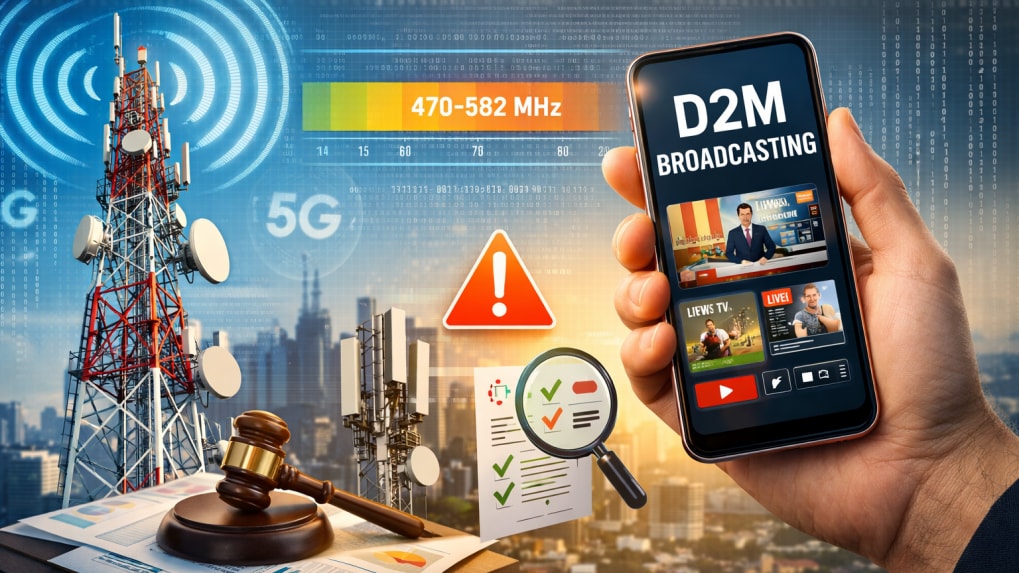
A comprehensive series of technical tests conducted by IIT Kanpur found that D2M broadcast technology operating in the 470–582 MHz frequency band does not interfere with 4G and 5G mobile networks and remains within acceptable thermal limits for consumer devices.

ADVERTISEMENT
Private telecom operators have challenged the recent technical tests conducted for Direct-to-Mobile (D2M) broadcasting, seeking fresh trials and consultations, even as a study commissioned by public broadcaster Prasar Bharati has concluded that the technology does not cause harmful interference to mobile networks or abnormal heating in smartphones.
A comprehensive series of technical tests conducted by the Indian Institute of Technology Kanpur (IIT Kanpur) found that D2M broadcast technology operating in the 470–582 MHz frequency band does not interfere with 4G and 5G mobile networks and remains within acceptable thermal limits for consumer devices. The findings were reviewed and certified by Bengaluru-based Aracion Technology Pvt. Ltd., a National Accreditation Board for Testing and Calibration Laboratories (NABL)-accredited facility.
The results are being seen as a significant milestone in India’s efforts to explore next-generation broadcast technologies for large-scale content delivery, particularly for live television and multimedia services on mobile devices without an active internet connection or SIM card.
However, the Cellular Operators Association of India (COAI), which represents telecom service providers such as Reliance Jio, Bharti Airtel and Vodafone Idea, has raised concerns over the manner in which the trials were conducted, arguing that they deviate from the transparent, consultative and technology-neutral framework outlined by the government.
What the tests found
Prasar Bharati had approached IIT Kanpur earlier this year after several stakeholders flagged concerns around potential interference with commercial mobile networks and the risk of handset overheating during D2M transmissions. IIT Kanpur, which has been collaborating with the public broadcaster since 2019 on next-generation digital terrestrial broadcasting standards, carried out test measurements on November 14, 2025.
The tests were conducted at a Telecommunication Engineering Centre (TEC)-designated facility operated by Aracion Technology and focused on two key areas: the thermal behaviour of D2M-enabled smartphones during audio-video playback, and the impact of D2M broadcasts on user equipment (UE) receiver sensitivity across LTE and 5G New Radio (NR) bands.
The trials used a fully ATSC 3.0-compliant “MarkOne” smartphone developed by Tejas Networks as the receiving device, while a 40-watt Broadcast Radio Head (BRH), model YOGA40W01, was evaluated as the D2M transmitter.
According to the final report, the D2M Broadcast Radio Head operating in the 470–582 MHz band “does not introduce any harmful interference or degrade the performance of IMT user equipment in commercial cellular bands”. The study also concluded that the thermal behaviour of D2M-enabled smartphones remained within acceptable operational limits.
Telcos flag concerns over process
Despite these findings, COAI has questioned the credibility and completeness of the exercise, stating that telecom operators and key device ecosystem partners were not involved in the trials and that the terms of reference (ToR) for the evaluation were not shared with stakeholders.
“Direct-to-Mobile broadcasting has far-reaching implications for spectrum, networks, devices and consumer safety. Any national-level technical evaluation of such a technology must be transparent, inclusive and technology-neutral, with active participation of all affected stakeholders,” COAI director general S P Kochhar said.
The industry body said its members had participated in earlier discussions and submitted detailed inputs to enable a credible, India-specific assessment of D2M technology. However, it claimed they were taken by surprise by the release of the technical test report, despite not being involved in the testing process.
COAI has urged the government to realign the D2M evaluation process with the principles discussed at a stakeholder meeting held in September, and to re-conduct the technical assessment with a comprehensive ToR finalised in consultation with all stakeholders.
Call for broader, technology-neutral evaluation
The association has sought a fresh, technology-neutral evaluation that considers all relevant D2M options, with participation from telecom operators, device manufacturers, chipset vendors, regulators and accredited laboratories.
It has also called for a structured public consultation under the aegis of the Department of Telecommunications (DoT) and the Telecom Regulatory Authority of India (TRAI), along with the development of standards, key performance indicators and benchmarks through an open consultative process led by the Telecommunication Engineering Centre.
According to COAI, the absence of telecom operators—whose networks and spectrum resources could be directly impacted by any large-scale D2M deployment—as well as device original equipment manufacturers, undermines the credibility of the conclusions drawn from the tests.
The industry body further argued that the scope of testing appeared narrowly confined to a limited set of parameters such as interference and device heating, while excluding several critical aspects needed for a holistic assessment. It said the test methodology did not adequately reflect India-specific spectrum allocations and deployment conditions, limiting the relevance of the findings for real-world network operations.
COAI also flagged concerns that the evaluation focused on a single technology standard, without assessing other comparable and globally relevant solutions, including cellular-based broadcast technologies. Such a selective assessment, it cautioned, risks pre-empting policy outcomes and could have unintended consequences for India’s digital and telecom ecosystem.
“A national-level assessment of D2M must allow a fair comparison of all viable technologies on parameters such as coexistence with IMT and 5G networks, scalability, device impact and long-term spectrum efficiency,” the association said.
Policy context
D2M broadcasting enables smartphones to receive live television, video and other multimedia content directly from terrestrial broadcast towers without using mobile data or a SIM card. While it is seen as a potential tool for mass content delivery and emergency broadcasting, it also raises questions around spectrum use, network coexistence, device design and consumer safety.
The information and broadcasting ministry had, during a meeting in September, directed that a comprehensive technical evaluation of D2M broadcasting be undertaken with clearly defined terms of reference, participation of all relevant stakeholders and inclusion of parallel technology options.
Reiterating its support for innovation in broadcasting and digital services, COAI said policy and regulatory decisions of this magnitude must be anchored in transparent, inclusive and technically rigorous processes to safeguard consumer interests, network integrity and the efficient use of national spectrum resources.