
They Thought He Was Mad to Drop the Name From the Logo — Until Mastercard’s Data Proved Him Right
How Raja Rajamannar pushed Mastercard to abandon marketing orthodoxy and rebuild the brand around data, emotion and experience.

ADVERTISEMENT
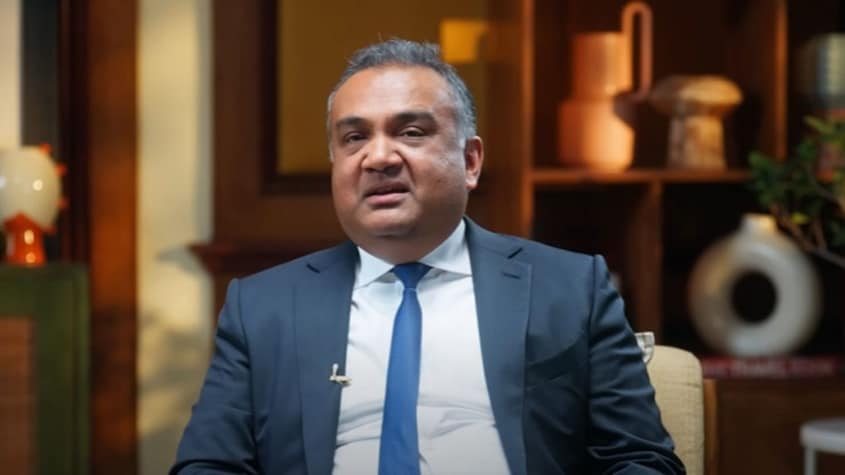
Raja Rajamannar, a senior fellow at Mastercard, has made a bet that many global chief marketing officers would hesitate to place. He cut the company’s advertising budget by more than 70 percent — not as a cost-saving exercise, but as a data-driven conclusion about what no longer works.
The decision emerged from a simple but unsettling insight. In a crowded media environment marked by shrinking attention spans, traditional advertising was failing to deliver measurable impact. With access to transaction-level data, Mastercard was able to examine causality rather than correlation. The results were unambiguous. Advertising, as a primary engine of growth, “was not doing what it was meant to do,” Rajamannar said.
Rather than retreating from marketing, Mastercard redirected its investments toward experiences designed to forge deeper and more durable consumer connections. “The need to communicate and connect with consumers still exists,” he said. “But the medium of how you connect and communicate changes completely.” That shift became the foundation of a broader reinvention of the brand.
Enter The Storyboard18 Awards For Creativity: Where Ideas Matter
From there Rajamannar began to dismantle many of marketing’s long-standing assumptions — frameworks largely built in a pre-digital era, before mobile devices, social platforms or artificial intelligence reshaped consumer behavior. The reappraisal led to a series of science-led decisions that reshaped how Mastercard presents itself to the world.
Perhaps the most visible was the decision to remove the company’s name from its logo. Grounded in neuroscience and refined through years of design testing, the simplified symbol was intended to trigger emotional recognition rather than verbal processing. The move was met with skepticism internally. Yet the results have been striking. Today, Rajamannar said, the Mastercard symbol enjoys 84 percent recognition even without its name.
WATCH
Another pillar of the transformation was multisensory branding. Challenging an industry that has traditionally relied on sight and sound, Rajamannar argued that meaningful brand experiences must engage all five senses. That philosophy now informs everything from Mastercard’s visual identity to large-scale live platforms designed to immerse consumers in the brand.
Purpose, too, has become central to Mastercard’s marketing strategy. Rajamannar has pushed back against the notion that marketing’s sole mandate is growth, arguing instead that social impact and commercial performance can be mutually reinforcing. “When you pursue a purpose, profits will definitely follow,” he said, pointing to initiatives such as the company’s long-running partnership with Stand Up To Cancer.
Underlying these shifts is what Rajamannar calls “quantum marketing,” a model that pairs extreme creativity with equally rigorous data and analytics. Many organizations struggle to strike that balance, he acknowledged. But those that successfully unite right-brain imagination with left-brain discipline are already seeing disproportionate returns.
Looking ahead, Rajamannar sees artificial intelligence as an essential force in an increasingly uncertain marketing landscape. With chief marketing officers now averaging tenures of less than three years, he argues that AI-driven platforms must absorb much of the analytical burden. Automation, he said, will enable leaders to move faster and make smarter decisions — without diminishing the role of human creativity.