
How Christmas became big business — and why Coca-Cola still owns the season
Long before digital ads and AI campaigns, retailers and brands transformed Christmas into a commercial engine—no company more successfully than Coca-Cola.

ADVERTISEMENT
By the time the first string lights go up outside a mall, Christmas has already begun its annual shift from holy day to high season: a ritual of inventory, spectacle and persuasion, built as much by merchants as by churches.
That arc is not new. In the United States, the commercial scaffolding of Christmas started taking recognizable form in the early 19th century, when a growing market economy found in December an unusually reliable excuse to sell goods, especially to families buying for children. By the 1820s and 1830s, retailers were advertising confections and keepsakes as gifts, helping turn a winter holiday into a shopping prompt.
Department stores then professionalized the idea. The US brand Macy’s, for instance, used elaborate window displays to glamorize manufactured goods—one 1874 display, the Smithsonian notes, featured thousands of dollars’ worth of imported dolls—and between 1880 and 1920, stores intensified holiday publicity through advertising and staging that made consumption look like tradition.
The trick was not merely to sell, but to make selling feel like belonging: a public performance of family, generosity and “the season,” with storefronts as theaters.
Even Santa Claus—now so familiar he feels timeless—was pulled deeper into commerce through retail. The American tradition of Christmas shopping took root as merchants began pitching wares explicitly as presents; in parallel, Santa’s modern story was being popularized through widely circulated writing.
Over time, department-store Santas and holiday displays turned myth into foot traffic.
It is in that tradition—Christmas as a mass-market story with commercial authors—that Coca-Cola built one of the most enduring brand associations in modern advertising: not Christmas “sponsored by Coke,” exactly, but Christmas remembered through Coke.
A winter problem, solved with a red suit
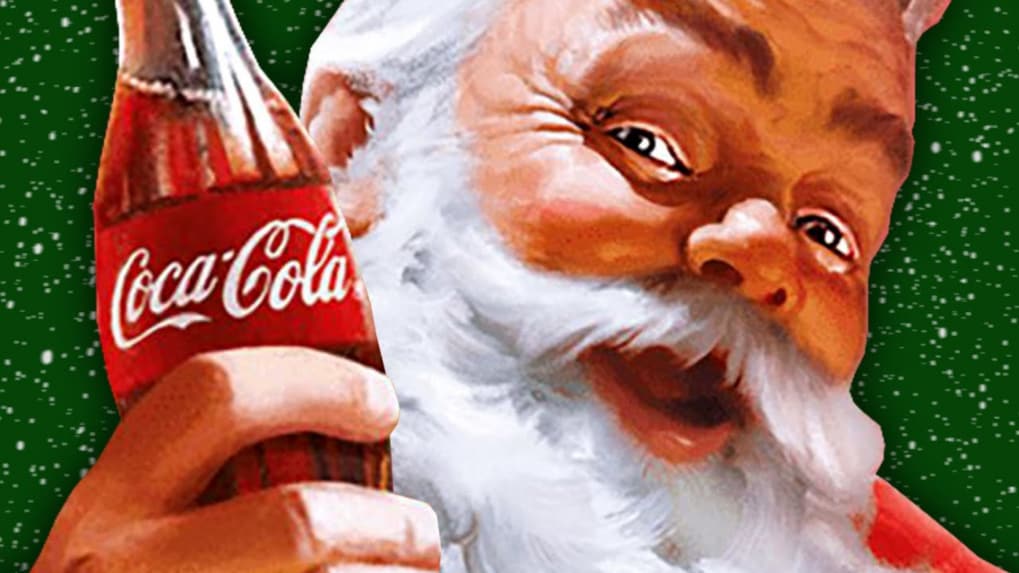
Coca-Cola’s early business challenge was seasonal: a cold drink sells differently when temperatures drop. In 1931, the company began placing holiday ads in popular magazines and commissioned illustrator Haddon Sundblom to paint Santa Claus for Christmas advertising. The company has described the objective plainly: link Coca-Cola with Christmas.
Sundblom’s assignment was not to invent Santa, but to humanize him at scale. Coke says its ad agency executive Archie Lee wanted a “wholesome” Santa who was “both realistic and symbolic”—Santa himself, not a man dressed as Santa.
Sundblom drew inspiration from the poem commonly known as “’Twas the Night Before Christmas,” according to Coca-Cola’s own account.
For roughly three decades—1931 to 1964—Sundblom’s Coca-Cola Santas appeared as recurring seasonal imagery, helping fix a particular version of Santa in the public imagination.
It is also why Coke has spent years correcting a stubborn myth: it did not “create” Santa Claus. What it did, by its own telling, was help establish Santa as a warm, happy character with human features that became widely recognized through repeated mass-media exposure.
In business terms, the achievement was not just an illustration. It was brand memory—built through repetition, distribution and emotional consistency. Coca-Cola’s Santa was an early proof that a company could rent space inside a cultural ritual, then eventually feel like part of the ritual itself.
When the ad becomes the calendar
If the Santa paintings were Coca-Cola’s long game, the trucks were its pop culture takeover.
In 1995, the company introduced the “Holidays Are Coming” campaign, created by ad agency W.B. Doner, featuring a convoy of illuminated Coca-Cola trucks.
Over time, the imagery grew into something closer to a seasonal signal than a sales pitch—an ad that, for many viewers, functions as an unofficial starter pistol for Christmas.
This is the modern commercial origins story in miniature: advertising doesn’t simply exploit the holiday; it starts to schedule the holiday. The same mechanism that department stores pioneered—spectacle as permission to buy—now arrives in a 30-second clip, replayed annually until nostalgia does the targeting for you.
And Coca-Cola has continued to treat that heritage as a strategic asset. In recent holiday campaigns, the company has explicitly framed its work as building on its “holiday heritage,” including experiments that fuse tradition with new technology.
In 2025, industry coverage described Coca-Cola again using AI-linked production in holiday work, reigniting debates about whether the future of seasonal advertising is craft, code—or, most likely, a blend.
This year captured the tension, as noted by the Financial Times: Coca-Cola’s AI-driven Christmas advertising drew criticism in creative circles even as consumer testing suggested strong effectiveness—an uncomfortable reminder that “authenticity,” as judged by professionals, does not always align with what moves mass audiences.
The larger lesson of Christmas’s commercial past
Step back far enough and Coca-Cola’s Christmas legacy looks less like a corporate coup than a late chapter in a longer history.
Writers and artists helped reshape Christmas into a family-centered holiday in the 19th century; retailers then learned how to monetize that domestic ideal without appearing crass about it. Some have argued that Christmas’s transformation into a commerce-heavy festival was driven by a coalition of writers, artists, retailers and, later, Madison Avenue, which was considered the capital of advertising for a concentration of ad agencies.
The Smithsonian’s account of department stores “sacralizing materialism” makes the point more sharply: selling worked best when it didn’t feel like selling, when consumption could masquerade as meaning.
Coca-Cola’s genius was to become a curator of that meaning—Santa as a warm face, trucks as a glowing procession, holiday messaging as a form of emotional infrastructure. The brand didn’t commercialize Christmas alone. But it gave the commercial Christmas one of its most stable visual languages.
What Coca-Cola’s Christmas still tells investors and marketers
The enduring value here is not only seasonal revenue; it is durability of association. Most campaigns age out. Coca-Cola’s Christmas assets—Sundblom’s Santa, “Holidays Are Coming,” the truck tour—have been engineered to compound.
And the next phase is already visible: how much of that compounding can be automated without breaking the spell. Coca-Cola itself is positioning new holiday work as an extension of heritage plus new tools.
The industry, meanwhile, is watching whether technology-enhanced production strengthens scale and personalization—or dilutes the human texture that made the tradition feel real in the first place.
Christmas began as a date on a religious calendar. It became, over two centuries, a commercial season with its own recurring scripts. Coca-Cola didn’t write the whole story—but it authored some of the lines people still quote, year after year, without even realizing they’re reciting an ad.