
Indian Advertising in 2025: A Year of Mergers, Mandates and Reset
From mega mergers and AI guardrails to regulatory crackdowns and shifting client mandates, 2025 marked a structural reset for India’s advertising ecosystem.

ADVERTISEMENT
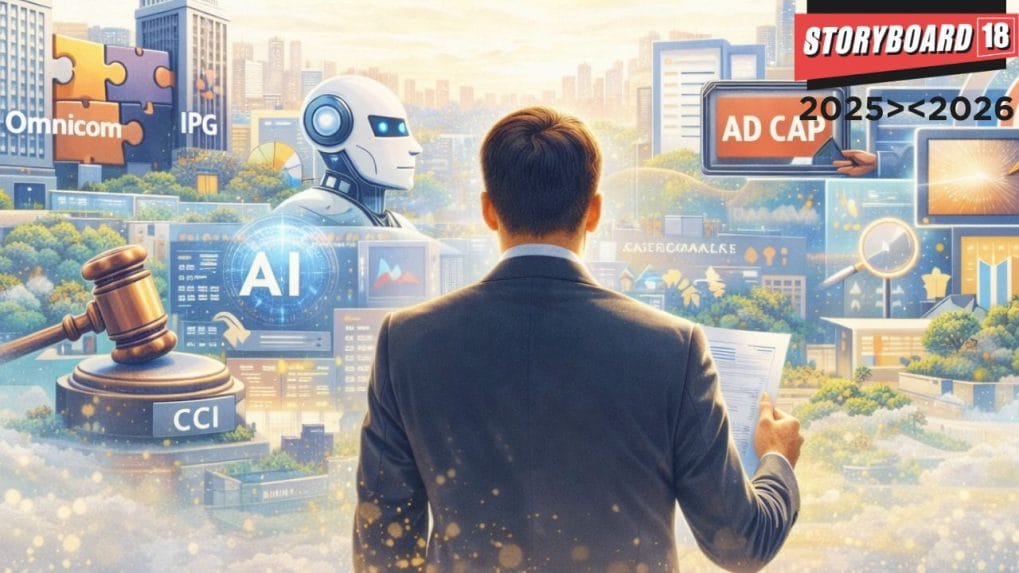
If 2024 was about recovery and cautious optimism, 2025 became the year Indian advertising fundamentally restructured itself. The industry didn’t just grow, it recalibrated. Power centres shifted, rules tightened, technology accelerated, and long-held agency models were forced to adapt to a new reality defined by scale, scrutiny and speed.
At the heart of this transformation was the Omnicom–Interpublic Group (IPG) merger, the largest consolidation in advertising history, whose ripple effects extended well beyond global boardrooms into Indian agency floors, client pitch rooms and talent pipelines. Alongside it, regulatory assertiveness, AI governance, evolving media economics and outcome-led client expectations combined to redraw the contours of the business.
Here’s a comprehensive list of the major events and shifts in the Indian advertising landscape in 2025, including regulatory moves, market trends, and structural changes.
The Omnicom–IPG Merger: Consolidation at an Unprecedented Scale
The single most consequential event of 2025 was Omnicom’s $13-billion acquisition of IPG, creating the world’s largest advertising and marketing services group with combined revenues exceeding $25 billion globally.
For India, the merger reshaped the competitive hierarchy overnight. The combined entity emerged as the second-largest agency group in the country, behind WPP, with an expansive portfolio spanning creative, media, data, health, experiential and technology services.
Beyond scale, the merger triggered structural rationalisation. Overlapping agency brands were retired or folded into core networks, signalling the end of several legacy names that had defined Indian advertising for decades. Leadership structures were flattened, shared services expanded, and integration became the dominant internal agenda.
Clients, meanwhile, responded with mixed reactions. While large advertisers welcomed greater buying leverage and cross-disciplinary depth, mid-sized and emerging brands raised concerns around agility, attention and turnaround times—questions that continue to shadow large holding company models.
CCI Scrutiny and the Return of Antitrust Conversations
In March 2025, the Competition Commission of India (CCI) conducted surprise raids on major global ad agencies like GroupM, Dentsu, Publicis, and IPG, plus industry bodies, investigating alleged cartelization, price-fixing, and bid-rigging on commissions and ad rates. Triggered by tips, the probe revealed suspected collusion via WhatsApp and informal agreements, potentially overcharging advertisers, with investigations now focusing on forensic data to uncover coordination in India's growing $18.5 billion ad market, potentially forcing major industry changes.
In parallel, the Omnicom–IPG deal also reignited antitrust discourse in Indian advertising. The CCI approved the merger but not without close scrutiny of market concentration, particularly in media buying, where scale directly influences pricing power. This approval marked a broader shift: regulators are no longer passive observers of advertising consolidation.
Steady Agencies > Big Networks : Marketers push back as agency turmoil threatens brand continuity
For agency groups, this translates into greater transparency expectations, tighter compliance, and heightened caution around exclusive arrangements and bundled offerings. For advertisers, it introduces the possibility of more disciplined pricing norms and a rebalancing of negotiating power, especially in high-spend categories like FMCG, e-commerce and BFSI.
Ad Spend Growth Holds Firm as Digital Tightens Its Grip
Despite structural churn, India’s advertising market continued its upward trajectory in 2025.
Industry estimates peg total ad spend growth in the 8–10% range, driven primarily by digital, retail media, online video and performance-led formats. Digital advertising accounted for well over half of incremental growth, fuelled by e-commerce, fintech, D2C brands and platform-led ecosystems.
India’s ad revenue to hit $22.7 billion; Growth to reach 9.7% in 2026: WPP Media
Television, while under pressure, showed resilience around marquee events such as the IPL, elections and major sporting properties. Print stabilised in select regional markets, while OOH leaned heavily on data-led planning and premium urban inventory.
The shift was less about channel replacement and more about reallocation, with brands demanding sharper ROI, attribution clarity and commerce integration across media plans.
AI Moves From Tool to Governance Issue
If 2023 and 2024 were about experimenting with AI, 2025 was about regulating it. The Advertising Standards Council of India (ASCI) unveiled an AI-ready regulatory roadmap addressing generative content, deepfakes, synthetic influencers, manipulated audio-visuals and disclosure norms. This was a decisive moment, positioning India among the few markets proactively shaping ethical advertising guardrails in the AI era.
India’s AI Copyright Gamble: DPIIT’s hybrid licensing plan sparks battle over consent and fair pay
For agencies, AI shifted from a productivity enhancer to a compliance responsibility. Creative automation, AI-assisted media planning and algorithmic targeting now come with accountability—forcing agencies to rethink processes, documentation and client assurances.
For brands, the focus moved to trust, authenticity and reputational risk, particularly in politically sensitive, financial and healthcare advertising.
Meanwhile, the Ministry of Electronics and Information Technology, under the IndiaAI Mission, unveiled the India AI Governance Guidelines, a national level framework to enable safe, inclusive, transparent and responsible AI adoption.
TRAI’s Ad Cap Enforcement Reshapes Broadcast Economics
Another regulatory lever tightened in 2025 was TRAI’s enforcement of advertising time caps on television.
Broadcasters, already grappling with fragmenting viewership and digital competition, were forced to rethink monetisation strategies as ad inventory limits constrained revenue potential. The result was a renewed push towards premium pricing, sponsorship integrations and hybrid content models.
No plans to regulate AI in scriptwriting yet, govt tells Rajya Sabha despite industry concerns
Advertisers, in turn, became more selective, prioritising high-impact placements over volume-led buying. The development accelerated the shift toward integrated TV–digital planning, where linear television became a branding layer rather than a frequency engine.
The Layoffs Distress
In 2025, layoffs emerged as one of the most disruptive undercurrents in advertising, reflecting structural pressures from consolidation, cost rationalisation and rapid technological change. The most visible impact stemmed from the Omnicom–IPG merger, which triggered global workforce reductions on a scale unseen in decades. As part of the post-merger integration, the newly combined group announced cut more than 4,000 jobs and the retirement of several legacy agency brands, including DDB, FCB and MullenLowe, largely affecting administrative, leadership and creative roles across markets.
From Pink Slips to Silent Sidelining: Inside adland’s layoff and anxiety crisis
These headline cuts followed earlier restructuring moves throughout the year, Interpublic Group alone shed around 3,200 roles in the first nine months of 2025 as it prepared for the acquisition, reducing headcount and real estate footprint as part of a cost-savings programme estimated at nearly half a billion dollars. Taken together with layoffs announced at other major holding companies and ripple effects across independent shops, industry analysts estimate that roughly 10,000 jobs, about 8% of the workforce was eliminated.
Beyond sheer numbers, the layoffs illustrated a deeper shift: advertising’s traditional labour model is being reshaped by automation, AI-driven production and efficiency mandates, forcing many longstanding roles to be redefined or sunset altogether. This contraction sparked anxiety across the talent market, with employees reporting waves of reductions throughout the year and expectations of continued turbulence into 2026.
Agency Mandates Signal a Shift in What Clients Want
One of the clearest signals of change in 2025 came from client mandate movements.
High-profile pitch reviews and account realignments increasingly reflected a demand for integrated, outcome-driven partnerships rather than siloed creative or media relationships. Brands sought agencies that could blend strategy, content, data, commerce and technology, often under a single P&L. It is to be noted that in 2025, major brands inlcuding the likes of Marico, Raymond Group, Flipkart and L'Oréal India initiated significant media/creative pitches, signaling big marketing shifts.
Independent and mid-sized agencies benefited from this shift, especially where agility, founder involvement and speed mattered more than sheer scale. Large networks retained dominance in high-spend, efficiency-led accounts, but the middle market became fiercely competitive.
Industry Conversations Pivot to Effectiveness, Not Just Creativity
Finally, the tone of industry discourse itself evolved.
Conferences, forums and award stages in 2025 moved away from vanity metrics toward effectiveness, ROI, business outcomes and marketing accountability. Creativity remained central, but increasingly as a growth lever rather than an end in itself.
Terms like retail media, first-party data, closed-loop measurement and commerce-led storytelling entered mainstream advertising vocabulary, emphasising how closely marketing is now tied to business performance.
Taken together, the events of 2025 point to something deeper than cyclical change. Indian advertising entered a structural reset, where scale and scrutiny coexist, technology demands governance, and agencies must continuously justify value beyond execution.